24 North Market Street, Suite 300
Jacksonville, Florida 32202
904-398-8000 Office Telephone
904-662-4419 Cellphone
904-348-3124 Fax
Email kent@williamkent.com
MR. KENT HAS AGAIN BEEN DESIGNATED FOR 2022 A "SUPER LAWYER" MEANING HE IS CONSIDERED TO BE IN THE TOP 5% OF APPELLATE ATTORNEYS IN THE STATE OF FLORIDA
Federal Criminal Appeals - Federal Habeas - 2255 - 2254 Nationwide
Florida Criminal Appeals and
Florida Rule 3.850 and 3.800 Motions Statewide
Florida Super Lawyer 2012, 2013, 2015, 2016, 2017, 2018, 2019, 2020 and 2021 for Appellate Practice
William Mallory Kent - Federal Criminal Appeal Lawyer - Florida Criminal Appeal Lawyer - Habeas Attorney - Federal Criminal Trial Lawyer
June 30, 1999 - June 30, 2022 - Twenty-third Anniversary of Our Current Office - Forty-four Years Experience as a Lawyer - Harvard College, A.B. cum laude, University of Florida College of Law, J.D. with Honors. Admitted to the Florida Bar 1978 - Admitted, inactive status, California Bar, Admitted in all Florida federal courts, Northern, Southern and Middle Districts of Florida, admitted in all federal courts of appeal except the First Circuit
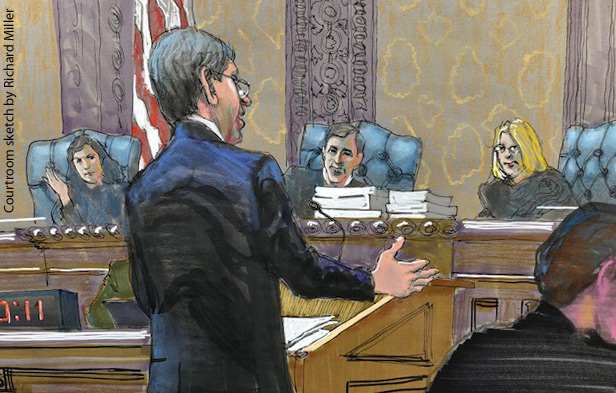
Hear Mr. Kent's oral argument at the United States Supreme Court in Terry Lynn Stinson v. United States which Mr. Kent won 9 to 0.
Hear Mr. Kent in oral argument at the United States Court of Appeals for the Eleventh Circuit, December 2013 in Bobby Smith v. United States, a pro bono habeas corpus appeal.
Ryan Edward McFarland - University of North Florida, B.B.A. in Economics, Florida State College of Law, J.D., Member of Law Review, Admitted to the Florida Bar 2017
This webpage en Espanol
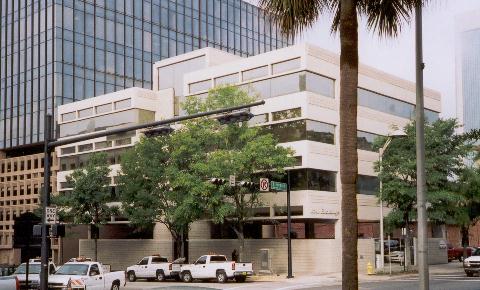
Our office is in this building, The Law Exchange Building, 24 North Market Street, Suite 300, located in the heart of downtown Jacksonville, Florida
TABLE OF CONTENTS - SAMPLE BRIEFS - RESUME AND EXPERIENCE
As of March 4, 2017, William Kent has been attorney of record on 773 criminal appeals, consisting of 374 federal criminal appeals and 329 state criminal appeals. In addition, Mr. Kent has been trial court level counsel of record in over 500 federal district court cases. At this point, we have quit counting!
RECENT APPELLATE, POST CONVICTION AND SENTENCING NEWS FROM OUR CASES
The appellate and post-conviction relief wins cited below are not meant to indicate that if you retain Mr. Kent that he will necessarily be able to win your case. Most appellate and post-conviction cases result in adverse decisions, meaning that the client loses, and the majority of state appellate cases are decided by the court without a published decision, referred to as a per curiam affirmed decision sometimes leaving the client with no further avenue of relief. However, this harsh reality makes it all the more important that a client choose his or her appellate or post-conviction counsel carefully, to insure that the best possible appellate or post-conviction brief or motion is presented to the court to increase the chance of success in what is in any event a difficult process. Mr. Kent cannot assure any client of success in his or her appeal or post-conviction proceeding but can only assure the client that he will use his very best efforts to achieve the best possible outcome for the client. A U.S. Department of Justice study done in 2000 for all federal criminal appeals from 1985-1999 showed that defendants had a substantially better chance of reversal on appeal if they had privately retained counsel than if they used court appointed counsel.
May 18, 2022, Volusia County Circuit Court Judge Clayton granted Mr. Kent's Florida Rule 3.850 Motion for our client, B.J., based on newly discovered evidence of a recanting key trial witness, setting aside a thirty year prison sentence following a trial guilty verdict arising out of a home invasion robbery.
February 28, 2022, Leon County (Tallahassee, Florida) state circuit court Judge Stephen Everett granted Mr. Kent and Mr. McFarland's combination Rule 3.800 and Rule 3.850 motion and vacated a mandatory life sentence for first degree murder for our client James Squaire, Jr., and allowed him to enter a plea to a lesser included charge of second degree murder and a time served sentence followed by life probation. Mr. Squaire was released the following day after the Department of Corrections cleared the release. His mother and father took him back home to Jacksonville where he enjoyed his first meal as a free man. Our client had served 25 years in prison when his family came to retain us. On its face it appeared to be a procedurally barred, hopeless case.
February 7, 2022, Mr. Kent and Mr. McFarland's client S.B. was charged 2019 in Clay County, Florida with sale of fentanyl in a case arising out of a controlled buy which was video recorded. After lengthy pretrial negotiations and depositions, the case was resolved February 7, 2022 on a lesser charge for probation.
January 19, 2022, Mr. Kent was retained to represent a client, M. R., for sentencing purposes only, who had been convicted at trial of a charge of being a felon in possession of a firearm after a prior felony conviction (and prior three year prison sentence) for aggravated assault. The state argued for a ten year prison sentence with a three year minimum mandatory. The charge carried a mininum mandatory sentence of three years. Mr. Kent argued for a three year minimun sentence. The court, Judge Jeb Branham, Fourth Judicial Circuit of Florida, after hearing argument of counsel imposed a four year sentence subject to a three year minimum mandatory. The client was pleased with the outcome of the sentencing.
August 31, 2021 - Florida First District Court of Appeal rules in Mr. Kent's favor in an attorney's fee appeal. The winning brief was written by Ryan McFarland.
August 2, 2021 - United States District Court for the Southern District of Georgia - Mr. Kent's client, a pharmacy owner, was originally indicted under 18 U.S.C. section 846 for conspiracy to distribute controlled substances arising out of an earlier indictment of a "pill mill" owner who was alleged to have conspired with Mr. Kent's client to use the pharmacy as the primary pharmacy to fill the illegitimate prescriptions issued by the "pill mill." However, after prolonged negotiations, a plea agreement was reached for a lesser charge of misprision of a felony and an unconditional recommendation of probation. The plea agreement was not conditioned on a proffer nor was there any substantial assistance or cooperation provided to the government in its case. At sentencing Judge Wood followed the government's recommendation and sentenced Mr. Kent's pharmacy owner client to probation and a $10,000 fine. There was no forfeiture and the pharmacy owner was allowed to keep the pharmacy business. This was a very good outcome for a case in which the guideline range initially appeared to exceed twenty years imprisonment.
June 30, 2021 Florida state Circuit Court granted Mr. Kent's post-conviction Rule 3.850 motion after an evidentiary hearing for our client, J.E., setting aside his trial conviction and 15 year prison sentence for trafficking in heroin and ordering the State to make an offer of time served which the client accepted and was released. Today is the 22nd anniversary of my opening my own then solo practice office, with the support and encouragement of my wife, Caroline. This is a wonderful anniversary present.
June 10, 2021, the Florida First District Court of Appeal affirmed in part and reversed in part the denial of habeas relief for our client R.A.C. The reversal was as to the summary denial of relief on the first ground in the habeas petition, a claim of ineffective assistance of counsel for failure to preserve for appeal the trial court's ruling on the admissibility of child hearsay statements. The underlying habeas petition (3.850 motion) was drafted and argued by Mr. Kent and the brief on appeal and oral argument was done by Mr. McFarland.
May 6, 2021 the Eleventh Circuit Court of Appeals in Atlanta in a 98 page en banc opinion vacated the conviction and sentence of Mr. Kent's client, former United States Congresswoman Corrine Brown, and remanded the case for retrial. The primary opinion was authored by Judge William Pryor.
May 6, 2021 the Ninth Circuit Court of Appeals in San Francisco tentatively scheduled Mr. Kent's federal habeas appeal of his client Galvin Gibson for oral argument. The oral argument may focus on what appears to be an issue of first impression - whether a Brady violation which occurred during a trial which resulted in a mistrial based on a hung jury can serve as a basis to vacate a conviction following a second trial at which the Brady issue played no part.
May 5, 2021 the Eleventh Circuit Court of Appeals granted a certificate of appealability on three grounds in Mr. Kent's appeal of his client Troy Curry-Pennamon's federal habeas appeal of his conviction and sentence for attempted murder. The District Court had previously granted habeas relief setting the case for retrial in state court, but had denied relief on the remaining grounds and denied a certificate of appealability on the remaining grounds.
February 23, 2021 the Eleventh Circuit Court of Appeals heard Mr. Kent's client former Congresswoman Corrine Brown's appeal en banc in United States v. Corrine Brown. Former Solicitor General Paul Clement joined the case pro bono for the oral argument. The single issue on appeal was whether the district court reversibly erred in discharging a deliberating juror over defense objection solely on the basis that the juror had prayed for guidance and felt that the Holy Spirit told him the defendant was not guilty - the trial court found this "disqualifying." This is a case of first impression in the federal courts and only one parallel case was found nationwide, a case before the Utah Supreme Court which permitted a juror to base his decision on a belief God had guided his decision after praying for guidance.
February 11, 2021 the federal Eleventh Circuit Court of Appeals in an appeal involving the First Step Act and the district court's discretion to reduce a sentence below the amended or modified guideline range issued a 13 page opinion for Mr. Kent's client Elijah Chisolm agreeing with Mr. Kent's argument that the district court's order was ambiguous whether the district court understood it had the discretion to reduce the sentence below the modified guideline range. The case was remanded for reconsideration by the district court.
December 3, 2020 Ryan McFarland successfully negotiated an incredible disposition of a felony child sex case for our client L.W. L.W. had been arrested and charged under Florida law in Volusia County, Florida with travel to meet a minor for sexual activity. This is a very serious felony offense which if convicted results in lifetime registration as a sex offender and ordinarily even under a plea agreement results in a prison sentence of several years. The equivalent federal charge carries a ten year minimum mandatory sentence. The Florida sentencing guidelines are about three years in prison. Mr. McFarland successfully negotiated a plea to a non-sex offense, felony child neglect, which will not result in L.W. being designated a sex offender or require any sex offender registration, and also negotiated a withhold of adjudication (which means under Florida law L.W. will not be considered a convicted felon for most purposes), and three years probation - not sex offender probation, just standard probation, with the agreement that the court will consider early termination of probation upon completion of the standard conditions of probation.
November 24, 2020, former Solicitor General of the United States, Paul D. Clement, who has argued more cases before the United States Supreme Court than any other attorney in history, filed his notice of appearance as co-counsel with Mr. Kent and Mr. McFarland on behalf of our client, former Congresswoman Corrine Brown, and together we filed our en banc brief at the Eleventh Circuit Court of Appeals for the appeal which has been granted en banc rehearing by the entire Court of Appeals, one of only four such cases out of over six thousand appeals at the Eleventh Circuit this year. Oral argument is set for the week of February 22, 2021. Former Solicitor General Clement will argue on behalf of our client. It is a great privilege and honor to have Mr. Clement on the case. We are also joined by the First Liberty Institute out of Plano, Texas, who came on the case for the petition for rehearing en banc. Six state attorney generals joined together in filing an amicus brief in support of our client's legal argument on appeal.
September 30, 2020, United States District Court enters 105 page order granting federal habeas filed by Mr. Kent pursuant to 28 U.S.C. 2254 for his client T.C-P., vacating a trial conviction and twenty-five year day for day mandatory sentence for attempted second degree murder.
September 24, 2020, the Eleventh Circuit Court of Appeals granted rehearing en banc for Mr. Kent in his appeal of the conviction of former Congresswoman Corrine Brown. This appeal presents a question of first impression in the federal courts involving First Amendment religious liberty rights and the disqualification of a sitting, deliberating juror. The First Liberty Institute of Plano, Texas joined in with Mr. Kent in the petition for rehearing. A divided panel had upheld Congresswoman Brown's conviction. Chief Judge William Pryor, however, authored a 60 plus page dissent to the divided panel opinion.
September 9, 2019, the Florida First District Court of Appeal ruled in favor of Mr. Kent's client, K.H., in a published opinion which upheld Mr. Kent's client's family law award of one half of the ex-husband's employee stock ownership plan, a $300,000 plan, and upholding Mr. Kent's client's award of 100% of the marital home. The District Court of Appeal also upheld the lower court's order in favor or Mr. Kent's client freezing the ex-husband's interest in his employee stock ownership to allow our client an opportunity to pursue further action against those assets. This was a civil, family law appeal, not our ordinary practice, but a matter we took on as a special request.
August 28, 2019, the Florida Fifth District Court of Appeal granted Mr. Kent's Petition for Writ of Prohibition on behalf of our client I.R., which had appealed Circuit Court Judge Howard Maltz's order denying Mr. Kent's Motion to Disqualify Judge Maltz.
August 28, 2019, the United States Attorney's Office announced at the status conference today that it intended to file a motion to dismiss the indictment against our client, Donjuan Powell based on the District Court having granted our dispositive motion to suppress.
August 20, 2019, United States District Court Judge Harvey Schlesinger overruled the Government's objections to the Magistrate Judge's Report and Recommendation in our client, Donjuan Powell's case, and entered an order granting our dispositive motion to suppress. The motion to suppress was dispositive meaning that without the evidence which is now being suppressed, the Government will not be able to go forward with its case. We anticipate a motion to dismiss the indictment will now be granted. Winning a dispositive motion to suppress in federal court is an extremely rare event.
July 16, 2019, United States Federal Magistrate Judge James Klindt issued a 53 page Report and Recommendation recommending that the dispositive motion to suppress filed and litigated by Mr. Kent on behalf of his client Donjuan Powell, be granted. If the report and recommendation is accepted by the District Judge, it will result in the federal firearm charges brought against Mr. Powell being dismissed. A copy of the report can be found here.
June 9, 2019 State Attorney agrees to drop firearm charges against Mr. Kent's client X. H.
June 6, 2019 State Circuit Court Judge Jon Morgan reduced Mr. Kent's client P.K's sentence for violation of probation from 15 years down to 5 years. This constituted a time served sentence and P.K. was released from the county jail without having to be returned to the state prison. Mr. Kent represented P.K. at the resentencing June 6th after two years of post-conviction litigation had succeeded in vacating the prior sentence and prior admission of violation of probation. The State had again argued for a 15 year sentence, but Judge Morgan denied the State's request.
May 25, 2019, internationally recognized Supreme Court practitioners Carter Phillips and Jeffrey Green of Sidley Austin LLP, Washington, DC, agree to sign on as pro bono co-counsel with Mr. Kent on the petition for certiorari in Mr. Kent's client, Michael Faircloth's, case at the Supreme Court. The issue presented is the right to the defense of transient innocent possession of a firearm when charged under 18 U. S. C. Section 922(g), possession of a firearm by a felon. Carter Phillips has had more oral arguments at the Supreme Court than any other private practitioner, over 83 arguments.
Mr. Kent represented former Congresswoman Corrine Brown at oral argument before the federal Eleventh Circuit Court of Appeals Friday, February 1, 2019. The panel was very interested in the issue presented on appeal, whether the district court abused its discretion in dismissing a hold out juror during jury deliberations. To listen to the oral argument, click here. A local news report on the argument by reporter Jim Piggott of Channel 4 TV, Jacksonville.
Taking on a pro bono civil circuit court dispute, Mr. Kent and Mr. McFarland jointly tried a civil case to conclusion and judgment in favor of their client, O. S., in Circuit Court in Nassau County, Florida January 7, 2019. O. S., a dock builder, was sued by a homeowner for breach of contract arising out of the rebuilding of a dock and appurtenances in Pirates Cove, Nassau County. The case was tried before the Honorable Steven M. Fahlgren, Circuit Court Judge who pronounced judgment for Mr. Kent and McFarland's client, O.S., at the conclusion of the trial.
October 16, 2018, state circuit court in Polk County grants in part sentencing correction motion filed on behalf of client T.M. reducing his 10-20-life 25 year minimum mandatory day for day sentence to 20 years minimum mandatory, leaving intact, however the thirty year non-minimum mandatory portion of the sentence. This will have the effect of allowing the client to receive all available credit time during the final ten years of his sentence. This motion was filed by Mr. McFarland.
August 21, 2018, state circuit court grants Mr. Kent's 3.850 motion for client Arthur Britt and resentences Mr. Britt to five years less prison, the minimum mandatory sentence permitted by law. An earlier sentencing, which had been challenged in the 3.850 motion, had violated the mandate rule and erred in running a five year count consecutive to two other counts, one a 25 year minimum mandatory count, the other a 20 year minimum mandatory count. The sentencing judge overruled the state's request to impose the 25 and 20 year minimum mandatory sentences consecutive to one another.
June 6, 2018, federal district court judge granted Mr. Kent's 3582 motion for client Jimmy W. reducing his sentence 61 months (5 years and 1 month).
April 19, 2018, the State conceded a motion to dismiss a felony opiate prescription fraud charge based on a statute of limitation argument made by Mr. Kent and Mr. McFarland in a motion filed under Florida Rule of Criminal Procedure 3.190(c)(4), based on a failure of the State to diligently search for the defendant after filing the criminal information against her. This motion brought back memories for Mr. Kent, because the very first dismissal of a criminal case he ever obtained was based on the same argument - over thirty years ago! Since then he has only used the argument one other time, in a complex federal drug conspiracy trial appeal and in that appeal (United States v. Charles Coleman) the defendant client's mandatory life sentence was vacated based on a challenge made by Mr. Kent to an underlying state predicate conviction which was infirm due to ineffective assistance of the former trial counsel in advising the defendant to plead to a felony drug charge when there was a viable statute of limitations defense available based on failure of the state to exercise diligence in arresting the defendant after charges were filed.
March 22, 2018, in response to a Motion to Dismiss Plaintiff's Motion to Reopen Case to Enforce Mediation Settlement Agreement and Motion for Entry of Consent Final Judgment filed by Mr. Kent in a civil matter in which Mr. Kent's client had entered into a civil mediation agreement part of which included execution of a stipulated judgment, opposing counsel withdrew his motion to enforce the judgment and took the case off the calendar. Although the vast majority of Mr. Kent's work is criminal, he is called on from time to time to represent clients in civil matters. The key to this motion was a technical defense under Florida law by which when parties enter into a mediation settlement with terms left to be executed, but as part of the mediation settlement agree to dismiss the case, the trial court loses jurisdiction to later enforce the terms of the settlement including any right to enter a stipulated judgment unless certain formalities are complied with in the motion to dismiss and in the agreed order of dismissal. Those formalities had not been complied with in this case, resulting in the party who had received the stipulated judgment not being able to have it entered. Mr. Kent's client had defenses to the matter but this technical defect obviated the need to present and litigate those defenses in the pending case.
February 5, 2018, Fourth Judicial Circuit Court grants Mr. Kent and McFarland's motion to dismiss a violation of probation in a sex offender felony case. The motion to dismiss argued that the grounds alleged in the violation of probation affidavit failed, as a matter of law, to allege matters upon which the court was authorized to violate probation. One such matter was an allegation that the client had failed s sex offender probation polygraph. The client was released from jail today as a result of this order.
January 29, 2018, after the Fifth District Court of Appeals granted Mr. Kent's motion to relinquish jurisdiction to the circuit court to permit the circuit court to conduct a hearing on Mr. Kent's motion to vacate his client's admission of violation of probation, the State Circuit Court Judge for Osceoloa County, Florida conducted a hearing and after hearing argument of counsel and considering Mr. Kent's written motion, over objection from the State granted the motion and vacated the admission of violation of probation. The client had been sentenced to serve 15 years in Florida State Prison based on the admission of violation of probation. The case has been set for a status conference in March to resolve the violation, which Mr. Kent has argued is invalid as a matter of law.
December 29, 2017 Mr. Kent filed a motion for release pending appeal at the federal Eleventh Circuit Court of Appeals for his client former Congresswoman Corrine Brown. The motion was denied January 22, 2018 by order of a single judge at the Eleventh Circuit. An application for bail was then submitted to Mr. Justice Clarence Thomas, the Supreme Court Circuit Justice for the Eleventh Circuit and is pending at the Supreme Court.
September 18, 2017, State concedes that Mr. Kent's state post-conviction motion (Rule 3.850 motion - the state equivalent to a federal 2255 or 2254 petition), must be granted for Mr. Kent's client, E.S., who had been charged with and pled guilty to attempted first degree murder and had been sentenced to 40 years imprisonment, in a case which at the time of the alleged crime had gathered substantial press attention. Mr. Kent had made a number of arguments that the plea was not a knowing and intelligent, free and voluntary plea, all of which the State ultimately conceded. The case is set for a status conference and retained trial counsel is now negotiating with the state for a reduced charge and reduced sentence.
April 23, 2017, a Florida Circuit Court accepted a negotiated disposition of a state 3.850 post conviction relief (habeas) motion for Mr. Kent's client, G.H., which reduced a 10 year prison sentence to just under 5 years and 7 months. The original sentence carried a ten year period of probation, which was modified to provide for court ordered drug abuse treatment and the possibility of termination after five years of successful completion of probation. The agreed upon disposition include an agreement that the State would waive the $100,000 fine that had been previously imposed. The 3.850 habeas petition had challenged a guilty plea which G.H. had entered pursuant to an agreement for the ten year sentence of imprisonment and ten years probation and $100,000 fine. Various claims were raised challenging the voluntariness of the plea, which were mooted by the agreed upon reduction and modification of sentence. Mr. Kent was assisted in the negotiation of the settlement of the claims by Florida Bar Board Certified trial attorney Teresa J. Sopp.
March 7, 2017, the Florida First District Court of Appeal reversed and remanded for resentencing before a new judge to be assigned by the Chief Judge of the Circuit the 15 year sentence imposed on Mr. Kent's client B.D. following a plea to DUI manslaughter. The case was reversed based on an unobjected to (fundamental) error that Mr. Kent raised for the first time on appeal, arguing that the trial judge reversibly erred in considering the delay the defendant put the court system through in exhausting her discovery and pretrial rights before deciding to plead guilty. Mr. Kent argued that this violated Due Process. The argument was strongly enough presented that the State Attorney General conceded error in its answer brief. A copy of the decision can be found here.
March 3, 3017, federal district court judge denies Florida Attorney General's motion to dismiss formerly pro se litigant's federal habeas petition (28 United States Code Section 2254 petition) as untimely, agreeing with Mr. Kent's briefing which argued that the petition in fact was timely. This case had a very complex and convoluted procedural history in state court which raised somewhat novel issues of AEDPA habeas timeliness. A copy of the federal judge's order can be found by clicking here. The case will now proceed to be determined on the merits.
March 2, 2017, State Circuit Court Judge grants Mr. Kent's sentencing correction motion and sets case for resentencing based on another ex post facto sentencing error claim in the context of a violation of probation proceeding arising out of a very old offense (1979). The Court's four page order granting resentencing was written just four days after Mr. Kent filed his motion. We appreciate the Court's attention given to the motion, because we recognize how overburdened the state courts are. The client was sentenced to 15 years in prison. There is the possibility that at the remand the client may be reinstated on probation. A copy of the Court's order can be found by clicking here.
November 29, 2016 United States District Court Judge Timothy Corrigan reduced Mr. Kent's client Juan Cadena's sentence 33 months, from 110 months to 77 months, after the Court had previously granted a federal habeas motion Mr. Kent filed on behalf of Mr. Cadena which had argued that Mr. Cadena was entitled to a resentencing. At the original sentencing in 2012 the provision in Mr. Cadena's plea agreement whereby the Government had agreed to recommend a two level reduction for acceptance of responsibility (despite Mr. Cadena's arrest in Texas for possession of one kilogram of cocaine while released on bond on his Florida federal drug case) was forgotten and no one argued for acceptance of responsibility, instead Mr. Cadena's new cocaine case in Texas was the focus of the sentencing, and the Court had denied Mr. Cadena any reduction for acceptance or responsibility. The habeas motion had argued that Mr. Cadena's defense counsel was ineffective for not arguing for acceptance of resonsibility at the original sentencing and that had he done so, the Court might have reduced the sentence for acceptance of responsibility. The Government had correctly conceded the error and the court had set the matter for resentencing, expressing reservations, however, whether the court would grant acceptance of responsibility given the intervening serious drug arrest. However, at the resentencing November 29, 2016 the Court agreed that although it was a close case, the Court would grant Mr. Cadena the two level guideline reduction. Mr. Cadena then also benefitted from the intervening reduction in the offense level for his drug offense under Amendment 782. (Because the resentencing resulting from the federal habeas motion came after the adoption of the guideline change, what had been a discretionary reduction under 18 USC 3582 became a mandatory reduction under USSG 2D1.1 for purposes of the resentencing.) The Government argued for a high end sentence at the new guideline range, but the Court imposed a low end guideline sentence and also included the RDAP (prison drug program) recommendation in the judgment, the net effect of all this will be that Mr. Cadena should serve about 24 more months in custody (subject to earlier release to community confinement or home detention for up to the final six months of confinement). Although this was "only" a 33 month reduction in the sentence, it is Mr. Kent's philosophy that any reduction in time in prison is invaluable. Life is precious and each day a father is away from his children, a son away from a mother, a husband away from a wife, is a day that can never be returned.
November 23, 2016, the State of Florida, Office of the Attorney General, filed its Answer Brief conceding error in a sentencing appeal Mr. Kent filed for his client B.M. Mr. Kent argued that his client was denied Due Process when the trial judge considered delay in pleading guilty in determining sentence. The State further agreed with Mr. Kent's argument that the remedy for this error is that the sentence be vacated and the case be reassigned to a new judge for de novo resentencing. The Court of Appeals is not required to accept the State's concession of error, but there is no reason to think the decision in fact will not be reversed. It is anticipated that the resentencing may reduce the sentence from 15 years to 10 years or less.
November 18, 2016 postscript to an appeal win from June 2016: earlier this year the First District Court of Appeal of Florida had ruled in Mr. Kent's favor for his client, Eric Riua Muturi, vacating his 100 year sentence (which had been based on running certain counts consecutive) and remanding for resentencing all counts concurrent with the exception of one count which was mandated to run consecutive. The effect of this decision was the sentence would be reduced from 100 years to 40 years which under current law would be 37.75 years actual time in custody - for a 19 year old client. However, on remand the State took the position that the court could engage in a de novo resentencing and increase the sentences on the separate counts that had to run concurrent to either reinstate the 100 year sentence or even go above that to life under the 10-20-Life statute. Mr. Kent referred the client to attorney Robert Shafer, who has a reputation for accomplishing outstanding results in state court in Jacksonville, where the resentencing was to take place. Mr. Shafer today succeeded in arguing to the trial court at the resentencing that the mandate rule limited the court to following the express mandate of the appellate decision, which did not suggest that the court could engage in a de novo resentencing. The trial court refused to increase the sentence and instead followed the express mandate of the appeals court and reduced the sentence from 100 to 40 years. This was outstanding work by attorney Robert Shafer. www.shafercriminallaw.com is the website for Mr. Shafer's firm.
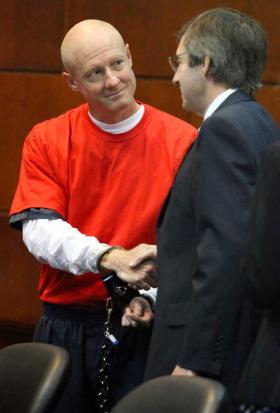
November 2, 2016 Mr. Kent's client, Theodore J. Payne, was sentenced to time served pursuant to a plea agreement for a time served sentence on a charge of armed robbery. This came after Mr. Kent had filed and litigated a 3.850 state habeas motion, which had argued that Mr. Payne had been denied effective assistance of counsel in relation to his rejection of a plea offer of six years. After rejecting the six year plea offer, Mr. Payne had gone to trial on a charge of armed robbery, been convicted and sentenced to 25 years imprisonment. The Court had previously granted the 3.850 motion on this claim and vacated the plea and conviction, but placed the case back on the trial calendar for retrial. Mr. Kent then successfully argued that the proper remedy for this type 3.850 claim was for the State to reinstate its previously rejected plea offer or if the State refused to do so, for the Court to order the State to reinstate the offer. At first neither the State nor Court agreed with Mr. Kent's position on the proper remedy. Mr. Kent had filed a memorandum of law in support of his argument that the proper remedy for this claim was reinstatement of the original plea offer. Following a meeting in chambers with the Court, the week before final pretrial, on the final pretrial date the State reinstated its prior offer of six years, waiving the 10-20-life minimum mandatory, and Mr. Payne entered a plea to that offer, and was sentenced to time served. Mr. Payne was released the following day after the Department of Corrections issued a clearance that he had no other holds. Below is a picture of Mr. Payne's Mother, smiling, after leaving court the morning his time served sentence was entered.
******************
September 1, 2016, after a hearing on Mr. Kent's 3.850 motion for client J. T., noted below, J. T. was released September 1, 2016. The Court vacated the 100 year (one hundred year) sentence of imprisonment that had been imposed for violation of his sex offender probation. Here is a photo (with the client's permission) of J. T. just after he had been released. July 26, 2016 the State had conceded in the course of negotiations after Mr. Kent filed a state habeas (3.850 motion) that J.T., was entitled to immediate release (subject to J.T. appearing before the court and accepting a modification of the terms of his probation to include a five year extension of the term of probation). This concession was made in response to Mr. Kent's 3.850 motion filed on behalf of his client, J.T., which challenged his 100 year prison sentence for violation of sex offender probation. The violation had been based on an allegation that J.T. was not in compliance with the terms of his electronic monitor condition. There had been a prior direct appeal (by other counsel, not Mr. Kent) which had affirmed the revocation of probation and 100 year sentence. Mr. Kent challenged the case on ex post facto grounds arguing that J. T. was never legally subjected to the electronic monitor order. Below is a photo made of J.T. moments after he walked out of custody, a free man for the first time since ordered to serve a 100 year prison sentence.
August 15, 2016, United States District Court Judge Timothy Corrigan granted Mr. Kent's federal habeas filed under 28 U.S.C. 2255 for his client Juan Cadena. The issue upon which relief was granted had to do with the failure of defense counsel to object to a breach of a plea agreement by the Government at sentencing. The Court will be ordering an updated presentence investigation report and setting the matter for a de novo resentencing. It is possible that the resentencing, if done in conformity with the plea agremeent which had been breached at the earlier sentencing, will result in a 40% lower sentence for Mr. Cadena. The judge, however, retains discretion to not reduce the sentence - this will be determined at the resentencing to be set in 60-90 days. The Government in effect conceded error in this case and we acknowledge their candor and professionalism in doing so.
July 26, 2016 the State conceded that Mr. Kent's client, J.T., was entitled to immediate release (subject to J.T. appearing before the court and accepting a modification of the terms of his probation to include a five year extension of the term of probation). This concession was made in response to Mr. Kent's 3.850 motion filed on behalf of his client, J.T., which challenged his 100 year prison sentence for violation of sex offender probation. The violation had been based on an allegation that J.T. was not in compliance with the terms of his electronic monitor condition. There had been a prior direct appeal (by other counsel, not Mr. Kent) which had affirmed the revocation of probation and 100 year sentence. Mr. Kent challenged the case on ex post facto grounds arguing that J. T. was never legally subjected to the electronic monitor order. The matter is being scheduled for a hearing at which the Court may accept the state's concession and the terms of probation be modified whereupon J. T. will be immediately released.
June 28, 2016 the Florida First District Court of Appeal reversed and remanded for resentencing Mr. Kent's client, Eric Riua Muturi. 21 year old Muturi was convicted at trial on six counts arising out of an alleged home invasion style robbery. The trial court, over Mr. Kent's objection, sentenced Muturi to 100 years imprisonment, consisting of 25 years each on each of counts one, two and three, and five years each on counts four and five, all to run consecutive for a total of 85 years imprisonment on counts one through five, plus 15 years imprisonment, consecutive, as to count six. Counts one through five were sentenced under the 10/20/25/Life minimum mandatory statute requiring day for day service of 81 years of the 85 year sentence. There was no minimum mandatory on count six and Muturi will be eligible for credit time. Under the Court's decision June 28 Muturi the consecutive sentences on the first five counts will be vacated and on resentencing required to be imposed concurrently, reducing the sentence on counts one through five from 85 years to 25 years - followed now by 15 years on count six subject to gain and credit time on that count. Under current gain time rules Muturi will serve 37.75 years on the new sentence (if the court does not reduce the 15 year sentence on count six at resentencing). This is still a terrible sentence, but it will permit Muturi to be released at age 58 instead of spending his entire life in prison. We hope that the future will hold legislative reductions in time served on such sentences.
May 26, 2016 Florida Fourth Judicial Circuit Court granted Mr. Kent's motion for post-conviction relief filed pursuant to Rule 3.850, Florida Rules of Criminal Procedure, vacating the trial conviction for armed robbery and 25 year prison sentence of client Theodore Payne. This habeas petition raised a Lafler v. Cooper - Missouri v. Frye plea issue. To read a copy of the Court's order, click here. It is anticipated that this ruling will result in Mr. Payne accepting the offer he had rejected pre-trial which will result in a time served sentence and his release from prison.
January 20, 2016, State Circuit Court in the Seventh Judicial Circuit of Florida grants Mr. Kent's sentence correction motion for client Andrew Hill, correcting a sentencing error which had the unintended result of depriving Mr. Hill of a concurrent sentence in a case involving both a state and a federal sentence. See copy of order here.
December 1, 2015, United States District Court, Middle District of Florida, sustained Mr. Kent's objection to the federal probation presentence investigation report which scored his client, Kevin Jackson, with a three level enhancement for role in the offense, that is, a partial organizer or leader role. After ruling in favor of Mr. Kent's objection on the role enhancement the District Court then agreed with Mr. Kent's argument that his client qualified for a two level safety valve reduction and was therefore no longer subject to the ten year minimum mandatory sentence that had been triggered by his indictment and conviction. The Court then further agreed with Mr. Kent's argument for a downward variance. The original presentence report guideline range had been 151-188 months, with a ten year minimum mandatory. The judge ultimately sentenced the client to 60 months. This sentence was NOT based on any substantial assistance.
November 16, 2015, Fourth Judicial Circuit Court granted Mr. Kent's post conviction motion to vacate the plea and conviction of his client, Y.P who had pled guilty and been convicted of the felony offense of obtaining prescription controlled substances by fraud. As part of a negotiated disposition of the case, Y.P. agreed to enter a plea to a withhold of adjudication on a misdeanor petit theft. The effect of this disposition is to protect Y.P.'s application for United States' citizenship.
September 30, 2015, the Third Circuit Court of Appeals affirmed in part and reversed in part the conviction and sentence of Mr. Kent's client, Joseph Nagle, in an appeal involving a Fourth Amendment claim and a sentencing claim. The case involved an indictment for alleged fraud in highway and bridge construction contracts for prestressed concrete beams and the use of Disadvantaged Business Enterprise (DBE) credits in connection with the contracts. Mr. Nagle was the CEO and controlling shareholder of the target company and went to trial preserving a Fourth Amendment issue relating to the search and seizure of the company's computer servers. He also preserved objections to his sentencing, which was based on a sentencing guideline calculation of loss amount based on the gross contract values, estimated to be in excess of $50 million. After oral argument on both issues, the Third Circuit Court of Appeals in Philadelphia reversed the sentence finding that Mr. Nagle should have been credited against loss amount for the value of the services provided. The Government had conceded that other than as to the character of the DBE credits, the Government received all it bargained for - the construction and erection of the concrete beams met or exceeded contract requirements. The Third Circuit remanded for resentencing. The Court of Appeals affirmed, however, the trial court's finding that Mr. Nagle, as the controlling shareholder and CEO of the family run business did not have standing to challenge the search of the company's servers. The primary sentencing arguments on appeal were made by attorney Ellen Brotman, who represented a codefendant. Mr. Kent adopted her arguments as to sentencing. [Update - November 30, 2015 - the District Court denied relief at resentencing, finding that the fair value of the services rendered should not include the profits derived from the contracts. It is expected that this will be appealed to the Third Circuit. Likewise, Mr. Nagle intends to seek certiorari on the Fourth Amendment issue at the Supreme Court.
July 17, 2015, Circuit Court Judge Mark Borello granted Mr. Kent's Motion to Vacate Plea and Sentence filed on behalf of his client Obed Cintron, and concurrently reduced Mr. Cintron's sentence from thirty (30) years imprisonment to ten (10) years imprisonment - a twenty (20) year sentence reduction. Mr. Cintron had pled without benefit of a plea agreement to conspiracy to distribute cocaine and six substantive cocaine sale counts and been sentenced some four years earlier. The State announced that it would not appeal Judge Borello's ruling.
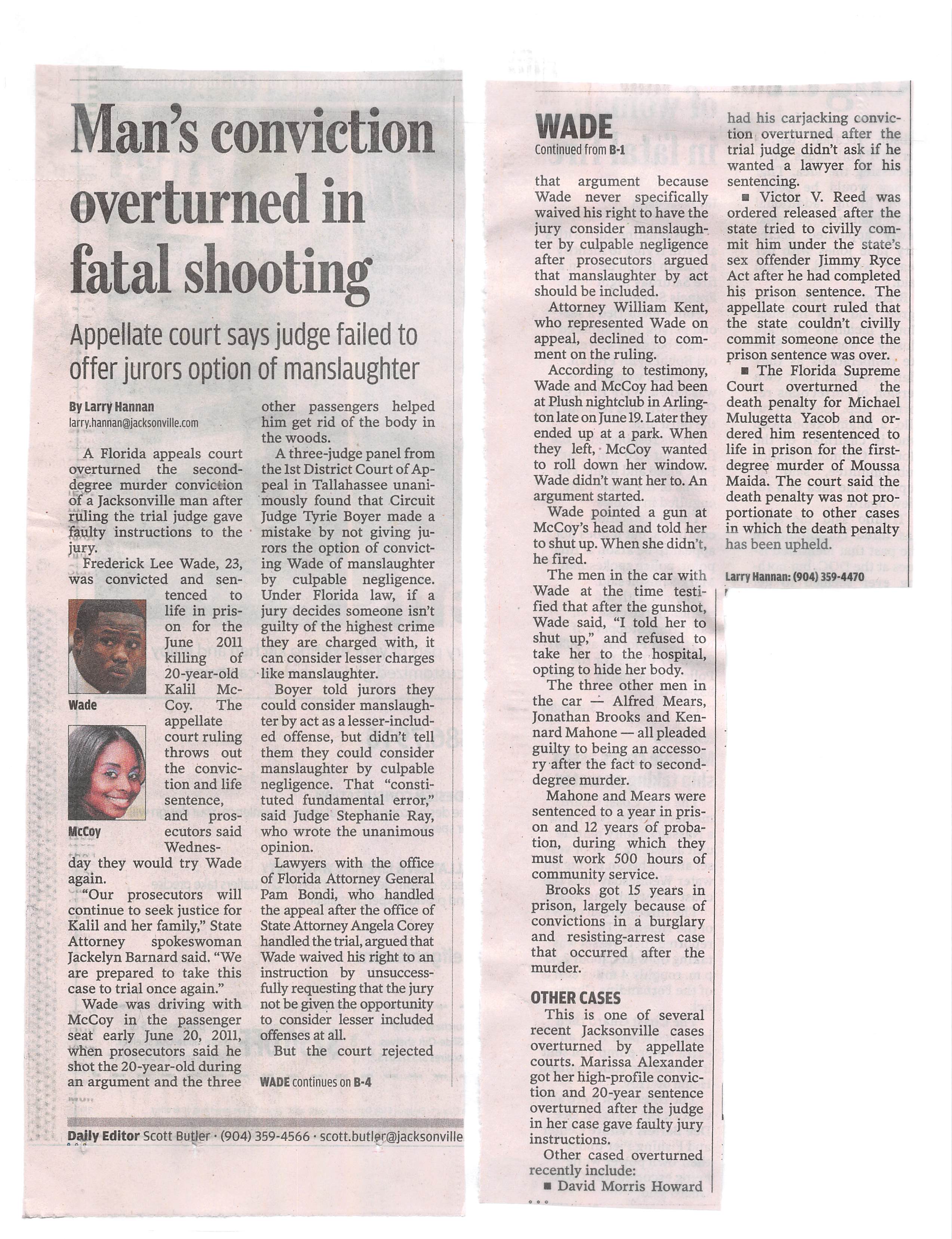
February 3, 2015, the Florida First District Court of Appeals reversed the conviction and life sentence of Mr. Kent's client, Frederick Lee Wade, based on Mr. Kent's argument that the trial court committed fundamental error in failing to give a lesser included jury instruction. A copy of the Court's opinion can be read here. The Court had this to say:
"Fredrick Lee Wade challenges his conviction for second-degree murder. The jury could have reasonably viewed the evidence as establishing second-degree murder, manslaughter by act, or manslaughter by culpable negligence. Although the court instructed the jury on manslaughter by act as a lesser included offense of the charged offense, the jury was not given the opportunity to consider manslaughter by culpable negligence. Under the facts of this case, the omission of instructions on manslaughter by culpable negligence constituted fundamental error. . . . We reject the State’s argument that Wade affirmatively waived the right to an instruction on the applicable manslaughter theories by unsuccessfully requesting that the jury not be given the opportunity to consider lesser included offenses at all. . . . For the foregoing reasons, we reverse and remand for a new trial."
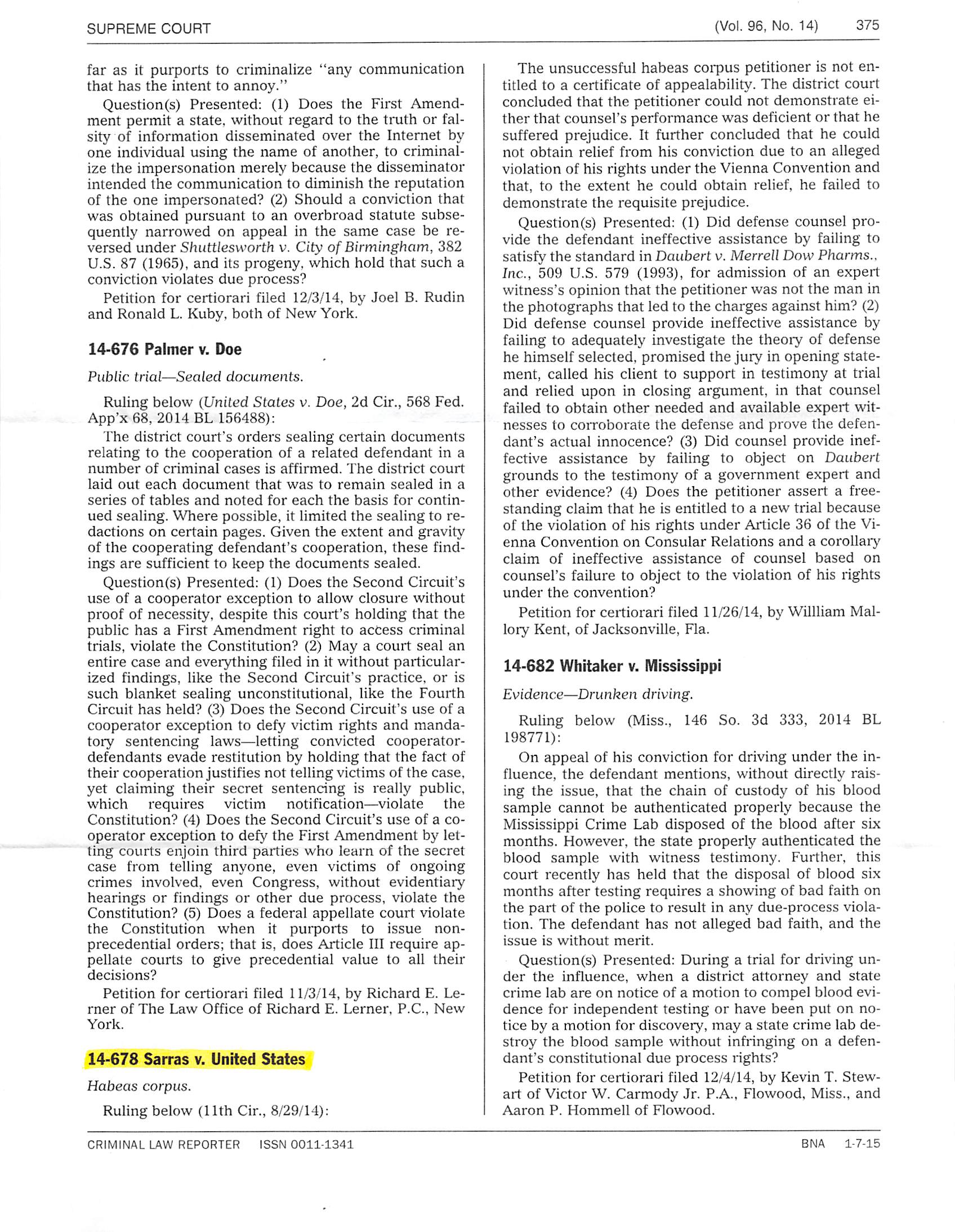
January 7, 2015, the BNA Criminal Law Reporter highlights Mr. Kent's petition for certiorari filed on behalf of client Donatos Sarras as a cert petition to watch. Sadly, the Supreme Court denied certiorari however.
January 6, 2015 Florida County Court Judge Wesley Poole grants without opposition from the State Mr. Kent's state post-conviction motion made pursuant to Rule 3.850 to vacate a plea and sentence on a first degree misdemeanor and the State concurrently agrees to dismiss the criminal charges. The motion raised various Due Process challenges to the plea and conviction, which the State did not concede but instead the State agreed to a vacation of the plea and sentence and dismissal of the charges on equitable grounds.
Florida Third Judicial Circuit Judge Leandra G. Johnson granted Mr. Kent's Stand Your Ground Immunity Motion November 7, 2014 dismissing a charge of second degree murder against Mr. Kent's client Lavell Nicole George. Ms. George had first been charged with first degree murder and tampering with evidence. Mr. Kent had objected at first appearance that the state did not have probable cause to establish first degree murder. The judge then gave the state 48 hours to file an amended complaint to satisfy the elements of first degree murder. The state instead reduced the charge to second degree murder. Mr. Kent then filed a motion to dismiss under Florida's Stand Your Ground immunity statute, arguing that Ms. George had acted in self-defense. The matter was set for an evidentiary hearing October 23, 2014. Mr. Kent filed two supplemental memoranda of law in further support of his motion to dismiss prior to the hearing. Mr. Kent's co-counsel, Richard Kuritz, was lead counsel for the evidentiary hearing. After two days of testimony Mr. Kent did a summary closing argument for the defense at which time Judge Johnson took the matter under submission. Judge Johnson issued her written order November 7, 2014 granting Ms. George immunity and ordering the dismissal of the second degree murder charge. Ms. George was also represented by attorneys Lewis Buzzell and Teri Sopp of Jacksonville as co-counsel on the case. A description of the case can be found here. UPDATE -The State has announced that it will NOT appeal the judge's order, so this ruling is final and our client Lavell George is free of this murder charge.
Following oral argument described below, the Third Circuit Court of Appeals in Philadelphia October 16, 2014 reversed on plain error grounds argued by Mr. Kent a life sentence under count two of a multi-count indictment for Mr. Kent's client Maurice Phillips. Phillips and ten co-defendants were indicted, convicted, and sentenced for their alleged involvement in what the Government called the "PCO," a large-scale interstate cocaine trafficking organization. Phillips allegedly led the PCO from 1998 until he was apprehended in 2007. According to the Government, the PCO had outlets in several jurisdictions, including New Jersey, Pennsylvania, New York, Maryland, the District of Columbia, and Virginia.Mr. Kent argued that the count in question, a continuing criminal enterprise conviction, was infirm due to both Rutledge and Richardson errors. Mr. Phillips is still subject to a life sentences on other counts. Chief Judge McKee wrote the opinion of the Court:
"Appellant Maurice Phillips appeals the convictions and sentences imposed after a jury convicted him of a number of charges stemming from his role as the leader of the Phillips Cocaine Organization (“PCO”). Among his numerous claims on appeal, Phillips contends that the District Court erred in convicting and sentencing him for both drug conspiracy (Count I) and operating a Continuing Criminal Enterprise (CCE) (Count II) because, as the Supreme Court held in Rutledge v. United States, 517 U.S. 292 (1996), drug conspiracy is a lesser included offense of CCE. Moreover, he claims that his CCE conviction should be vacated because the Court’s charge on the CCE offense failed to instruct the jury that it must unanimously decide which violations constituted the “continuing series of violations” underlying the charge, as required by the Supreme Court’s decision in Richardson v. United States, 526 U.S. 813 (1999). For the reasons that follow, we will vacate Phillips’s conviction and sentence for Count II, the CCE charge. However, we will affirm the District Court with respect to all other issues raised on appeal."
The United States District Court for the Northern District of Illinois, Chicago Division, set an evidentiary hearing for Mr. Kent's client Li Xin Wu, on a 2255 habeas petition filed by Mr. Kent challenging among other matters the inadequacy of Mr. Wu's English comprehension and the impact that had on his representation and decision to take his case to trial rather than enter a plea. The hearing is set for June 19, 2014 in Chicago. The hearing has been continued and no new date set yet.
The Third Circuit Court of Appeals in Philadelphia has granted oral argument in Mr. Kent's appeal for client Maurice Phillips. The oral argument is scheduled for May 23, 2014. Mr. Phillips was convicted after a lengthy trial of drug conspiracy and murder for hire. The Court of Appeals in a notice to the parties has asked Mr. Kent to focus his oral argument on two plain error sentencing arguments raised in his brief, both of which challenge life sentences imposed against Mr. Philliips. One issue involves Double Jeopardy as applied to conspiracy and RICO, and the other involves required predicate acts for RICO. Oral arguments are said to be rare in criminal cases in the Third Circuit and this is particularly remarkable considering that the Court has expressed interest in two plain error issues raised by Mr. Kent for the first time on appeal.
April 24, 2014, United States District Court on remand from Mr. Kent's successful breach of plea agreement appeal to the Eleventh Circuit, which argued that government breached its obligation to support acceptance of responsibility at sentencing, a newly assigned District Court Judge reduced client Bryan Copeland's sentence from 22 to 17 years. The resentencing was handled by attorney Donald Mairs under the CJA. This five year sentence reduction was a result of Mr. Kent's sucessful appeal for Mr. Copeland, who had been charged in a five million dollar tax fraud scheme.
February 13, 2014, State Circuit Court Judge granted Mr. Kent's 3.850 motion for client P.N., vacating his guilty plea, judgment and sentence to ten years Florida State Prison and immediately thereafter the Court accepted a negotiated plea agreement tendered by Mr. Kent on behalf of N.P. reducing the prison portion of his sentence from ten to five years. The probationary term of the original sentence and restitution remained as previously imposed. The 3.850 motion argued that N.P. had not knowingly pled guilty to a first degree grand theft when his attorney both tendered a plea to first degree grand theft while at the same time continued to dispute the loss amount and asserted a loss amount below the grand theft $100,000 predicate. The court found no ineffective assistance of counsel but instead found that the plea was not knowingly and intelligently entered.
January 31, 2014, the Florida Fifth District Court of Appeal issued a show cause order to the State Attorney General why Mr. Kent's habeas petition for ineffective assistance of counsel in a case of lewd battery, should not be granted. The issue in this habeas was whether it was ineffective assistance of counsel on the part of the prior appellate lawyer for the client, M.P., to voluntarily dismiss his direct appeal of sentencing following a guilty plea to lewd battery. The underlying issue was whether lewd battery requires a 25 year minimum mandatory sentence or whether the sentencing judge has the discretion to impose a lesser, non mandatory sentence. Although an order to show cause is not a final order and does not necessarily mean that the court ultimately will rule in the defendant's favor, given the posture of this case, in this case it does indicate that the District Court of Appeal is inclined to grant relief unless the State can convince the court otherwise. [The DCA subsequently dismissed the habeas but Mr. Kent has a parallel issue pending in a 3.850 motion with the trial court.]
January 30, 2014, Mr. Kent has an evidentiary hearing in federal district court in Tampa, Florida for his client Abram Thompson on a 2255 Lafler claim. The appearing went well and the court requested both the Government and Defense to submit proposed findings of fact and conclusions of law. Here is a copy of Mr. Kent's proposed findings.
January 29, 2014, the Government concedes that Mr. Kent's client N.R. is entitled to an evidentiary hearing on three of his 2255 claims relating to misadvice of counsel whether to accept a plea or proceed to trial and the sentencing consequences of a trial. This federal habeas involves claims that N.R. produced child pornography. If the federal district court accepts the Government's concession the evidentiary hearing will be conducted in the Southern District of Alabama, Mobile Division.
January 27, 2014, a federal district judge imposed a below guideline sentence on Mr. Kent's career offender client, A.M., of 65 months, to run concurrent to an unrelated state sentence A.M. is currently serving, which will have the net effect of causing A.M. to serve 34 months in federal custody for the new federal offense. A.M. was a career offender whose guideline range as a career offender was 151 to 188 months. A.M. had been caught in an ATF sting operation in which A.M. brokered the sale of a stolen firearm after completing a sale of less than one gram of crack cocaine to a confidential informant. Mr. Kent represented A.M. from plea through sentencing.
January 9, 2014, State Circuit Court agrees to grant Mr. Kent's state post-coviction 3.850 motion reducing a term of imprisonment from ten to five years on a post conviction motion which challenged Mr. Kent's client, P.N.'s, guilty plea to and sentencing on a first degree grand theft as part of a proposed negotiated settlement of the claim. The Court also proposed fixing a set monthly payment on P.N.'s restitution obligation.
December 13, 2013, in a second Padilla v. Kentucky win in as many weeks, another Florida State Circuit Court granted relief for a second client of Mr. Kent's in vacating a 12 year old felony conviction, which, if not vacated, would have resulted in this client being deported to Cambodia, a country he has never seen. This client was born in a United Nations refugee camp in Thailand after his mother fled a Khmer Rouge death camp in Cambodia. His siblings all died in the Cambodia Killing Fields. He was sponsored by a local United Methodist Church to enter the United States as an infant in his mother's arms. Until recently such persons were not deportable as a practical matter because Cambodia refused to accept the repatriation as Cambodian citizens refugees who were born of Cambodian parents outside Cambodia in United Nations refugee camps. Likewise, Thailand did not accord citizenship to refugees born on Thai soil in U.N. refugee camps - leaving persons such as this client stateless. Under pressure, however, from the current administration, Cambodia relented and ICE had started removing persons with convictions rendering them removable. We want to thank the local ICE office, however, for patiently working with our client and withholding action on his removal until the court had resolved his post-conviction claim. We also thank Florida Fourth Circuit Court Judge Mark Hulsey, III, who granted our client's 3.850 motion on the basis of Padilla and manifest injustice grounds. For a video clip of Judge Hulsey, please follow this link. For another short video on Judge Hulsey, please follow this link.
December 6, 2013, Florida State Circuit Court grants Mr. Kent's state habeas motion filed under Rule 3.850, Florida Rules of Criminal Procedure, setting aside his client, Alejandro A.'s guilty plea and conviction for possession with intent to distribute cocaine, based on Mr. Kent's argument that Alejandro A.'s trial counsel rendered ineffective assistance of counsel under Padilla v. Kentucky, the Supreme Court decision which held that a criminal defense attorney has a duty to clearly advise the client that his plea and conviction will - not may - but will result in his deportation, if the offense of conviction is an aggravated felony triggering mandatory removal proceedings. The client barely escaped deportation, being saved only by the Circuit Court's timely writ ad testificandum which Mr. Kent had the court issue to bring Mr. A. from the federal immigration detention center at Krome after he had already been ordered removed in immigration proceedings.
November 13, 2013, the Florida Fourth District Court of Appeal reversed a circuit court order denying a 3.850 post-conviction relief order as untimely, holding that belated amendment had only "enlarged" timely filed claims, in Marc Cooper v. State of Florida. Mr. Kent represented Mr. Cooper on the appeal of the untimely 3.850 motion.
September 24, 2013, after Mr. Kent filed an appeal of five separate orders of direct contempt of court against his client D.P., in Duval County, Florida case number 16-2013-MM-000196-AXXX-MA, which sentenced D.P. to two years in county jail for contempt of court, trial judge granted Mr. Kent's Rule 3.800 motion and reduced sentences on all five contempt orders to time served, after which Mr. Kent entered a voluntary dismissal of the appeal.
August 19, 2013, State Circuit Court Judge Tatiana Salvador granted, in part, a sentencing correction motion filed by Mr. Kent for his client, Frederick Wade, and set Mr. Wade for de novo resentencing at a date to be later determined. Mr. Wade was convicted after trial of murder which had as an element his alleged actual use and discharge of a firearm resulting in the death of the victim. Under Florida's 10-20-Life statute, this triggered a minimum mandatory sentence. Mr. Wade, who was just 20 years old at the time of the alleged offense, was sentenced to mandatory life imprisonment. Mr. Kent argued in his sentencing correction motion that the original sentencing judge (not Judge Salvador), had been mistakenly advised by the State at sentencing that the Court was required to impose mandatory life imprisonment. Mr. Kent argued, and Judge Salvador agreed, that the statute only required a 25 year minimum mandatory sentence. For a copy of the order click here.
August 7, 2013, United States District Court for the Middle District of Florida, Tampa Division, sets Mr. Kent's client Abram Thompson's federal habeas under 28 U.S.C. Section 2255 for an evidentiary hearing on his claim that before proceeding to trial in a federal drug conspiracy, his counsel failed to adequately explain the benefits and/or consequences of pleading guilty as opposed to proceeding to trial, including application of the sentencing guidelines and that counsel failed to adequately discuss with Thompson the strength of the Government's case.
August 1, 2013, Eleventh Circuit Court of Appeals schedules oral argument for November 6, 2013 on consolidated cases including Mr. Kent's client, Saheed Thompson, in an appeal of a trial conviction and sentence in a drug and firearm conspiracy. The key issue for Mr. Kent's client is a challenge to a 924(c) five year consecutive minimum mandatory sentence which was predicated on Pinkerton liability.
July 23, 2013, United States District Court for the Eastern District of North Carolina denied Government's motion to dismiss on primary claim raised by Mr. Kent in a federal habeas petition under 28 U.S.C. Section 2255 for client J.G. and directed the magistrate judge to enter an appropriate scheduling order leading to an evidentiary hearing on this claim. Mr. Kent argued that J.G.'s primary trial counsel had provided ineffective assistance of counsel by counseling J.G. to enter a plea of guilty to a 15 year minimum mandatory production of child pornography count, without advising J.G. that the series of six search warrants which led to the seizure of the alleged child pornography were subject to challenge by way of a motion to suppress.
May 29, 2013, the federal Eleventh Circuit Court of Appeals granted relief to Mr. Kent's client, Bryan Adrain Copeland, in an unpublished 12 page opinion. Mr. Copeland had pled guilty to charges arising out of a scheme to defraud the Internal Revenue Service of approximately $5,000,000. The money has not been recovered. In its opinion, per curiam by Judges Carnes, Barkett and Hull, the Court found that the Government breached its plea agreement with Mr. Copeland and ordered resentencing, mandating specific performance of the plea agreement, and further ordering that the resentencing be conducted by a new judge. A copy of the slip opinion can be found here.
March 21, 2013, Circuit Court Judge Mallory Cooper granted Mr. Kent's Florida Rule 3.800 motion which had argued that our client Amir Ali had improperly been sentenced as a habitual offender, and over the objection of the State reduced Mr. Ali's sentence to time served as a non-habitual offender.
March 20, 2013, United States District Court Judge Timothy Corrigan conducted the resentencing for Mr. Kent's client T. B., on remand from the 11th Circuit Court of Appeals. T. B. was one of the early cases affected by the dispute whether the Fair Sentencing Act of 2010 (which reduced crack cocaine minimum mandatory penalties), applied to defendants whose offenses were committed prior to the effective date of the act. At the original sentencing in early 2011 Judge Corrigan followed what had by then become a wave of precedent that the act did not apply retroactively - even Families Against Minimum Mandatories had concluded the act did not apply retroactively. However, Mr. Kent preserved a challenge to the act by rejecting a government plea agreement which required a sentencing appeal waiver and had his client plea straight up to all six counts of his indictment, then preserved the legal challenge by both a presentencing memorandum of law and contemporaneous sentencing objections which argued the act did apply retroactively. Ultimately the United States Supreme Court held that the FSA applied retroactively, at which point the Government conceded errror on T. B.'s appeal which was then pending at the 11th Circuit. At the resentencing March 20, 2013, Judge Corrigan reduced T. B.'s original ten year minimum mandatory sentence to the new minimum mandatory of five years - i.e., the sentence was cut in half. T. B. was represented by Mr. Kent at the original plea, sentencing, on appeal and at the resentencing. Thanks to Judge Corrigan for his exercise of his sentencing discretion in this manner.
March 18, 2013, State Attorney for the Florida Fourth Judicial Circuit concedes error to Mr. Kent's second and successive fundamental sentencing error Rule 3.800 motion for his client Amir M. Ali, which argued that Mr. Ali was improperly sentenced following trial as a habitual offender. The legal argument turned on the retroactive application of an amended version of the habitual offender statute and a change in the language which extended the reach of the five year reach back to controlled release status cases. This was a highly technical argument and we compliment the State Attorney on its attention to the correct application of the law.
March 4, 2013, Clay County, Florida County Court Judge Richard Townsend granted Mr. Kent's state post conviction motion under Florida Rule of Criminal Proecdure 3.850 and vacated and set aside client M.I.'s plea and conviction for possession of marijuana - which conviction has been the basis of a removal proceeding brought against M.I. by the Department of Homeland Security, Immigration and Customs Enforcement. The motion was predicated on the failure of the court at the time the plea was taken to adequately warn M.I. of the deportation consequences of his plea.
January 16, 2013, Orlando, Florida Circuit Court Judge Renee Roche, at a second resentencing hearing granted in response to a Rule 3.800(b) motion by Mr. Kent, further reduced client M.H.'s sentence from an eight year adult sentence to a four year youthful offender sentence. At the first resentencing the court agreed to reduce the sentence to a youthful offender sentence, but only reduced the sentence from eight to six years; at this second resentencing the court reduced the sentence a further two years, cutting the sentence in half from the original sentence. M.H. was represented at the resentencings by attorney David Fussell, former President of the Florida Association of Criminal Defense Attorneys to whom Mr. Kent had referred M.H. after Judge Roche granted Mr. Kent's resentencing motion.
January 18, 2013, in case number 3:10CR101-002 in the United States District Court for the Northern District of Florida, Pensacola Division, concluding four days of sentencing hearing, Mr. Kent's client Dr. Gerard DiLeo was sentenced by Chief United States District Judge Casey Rodgers to 24 months imprisonment followed by one year home confinement after having been convicted following a six week long trial in which Dr. DiLeo was charged with one count of conspiracy to distribute controlled substances and one count of money laundering for his role as a doctor in and co-owner of a pain clinic company, which the Government had characterized as a "pill mill." The original presentence investigation report in Dr. DiLeo's case had found that Dr. DiLeo was subject to 20 years imprisonment for the drug conspiracy and up to 20 years imprisonment for the money laundering conviction (for a total exposure of 40 years), and his guideline range was originally calculated to be 292 to 365 months (24 years 4 months on the low end to 30 years 5 months on the high end). Mr. Kent objected noting that the Government had failed to ask for a special verdict to establish jury unanimity on which of several classes of drugs charged in the drug conspiracy count had been the object of the conspiracy as to Dr. DiLeo. This objection was sustained, resulting in the maximum statutory penalty for the drug charge being reduced to 3 years from 20 years and reducing the cumulative exposure to 23 years, which was less than the PSR guideline range of 292-365. Next, Mr. Kent objected that the patients of the pain clinic were not vulnerable victims, an objection overruled by Probation, but accepted by the district judge at sentencing, thereby reducing the guideline range 4 levels, from a Total Offense Level 40 to a Total Offense Level 36 and a sentencing range of 188-235 months (15 years 8 months to 19 years 4 months). Mr. Kent had argued in a written sentencing memorandum that Dr. DiLeo was entitled to a downward variance or departure for extraordinary family responsibilities under U.S.S.G. Section 5H1.3, due to the care required for a severely disabled adult son. After an initial objection by the Government, later withdrawn, the district judge departed downward an additional 12 levels to a range of 51-63 months under 5H1.3. Following that departure, the district judge then accepted a number of statutory sentencing factors noted by Mr. Kent in his written sentencing memorandum under 18 U.S.C. Section 3553 and departed downward an additional 7 levels to level 17 and sentenced Dr. DiLeo at the low end of that range, 24 months. This was a 19 level downward departure/variance after a six week long trial and guilty verdict on all counts, the most extreme sentence reduction Mr. Kent has ever obtained in over 25 years practice as a criminal defense attorney. This sentencing was the joint work of Mr. Kent, who authored the PSR objections and sentencing memorandum, and trial counsel for Dr. DiLeo, attorney Guy Womack (www.guywomack.com), who presented the crucial witnesses at the evidentiary hearing in support of the departure and 3553 variance then summarized the arguments for departure and variance. Judge Rodgers allowed a voluntary surrender and sua sponte agreed to not only recommend placement at the Federal Prison Camp Pensacola, but that she would personally call BOP and urge the designation. Based on Mr. Kent's objections and grounds for departure and variance, the sentencing guidelines in this case went down from more than 30 years imprisonment to just 24 months imprisonment. On a 24 month sentence, Dr. DiLeo would be expected to serve no more than 20 months, as much as 12 months of which, under the Second Chance Act, may be in home confinement, such that the actual period of incarceration may be as little as 8 months. This sentence would not have been possible but for the compassion and judgment of Chief United States District Judge Casey Rodgers, who put a herculean effort into the sentencing process, recognizing the extraordinary good character and family circumstances of Dr. DiLeo, the help of United States Probation Officer Michael Constantakos, and the grace of United States Attorneys Randall Hensel and Alicia Kim, who did not ask for a specific sentence for Dr. DiLeo, but instead acknowledged that he was entitled to a downward departure in the judge's discretion and further advised the court that the Government had no objection after sentence was imposed.
November 13, 2012 the United States conceded error in Michael W. Johnson v. Warden, FCC Coleman-USP-I, in the United States District Court for the Middle District of Florida, Case Number 5:11-cv-42, to a federal habeas petition filed under 28 U.S.C. Section 2241 and the "savings clause" of 28 U.S.C. Section 2255(d), challenging a 21 year 10 month (262 month) Armed Career Criminal sentence entered by a district court in 2003 in Missouri. This client had exhausted all his prior remedies after challenging the ACC sentence at sentencing, on direct appeal after trial, in a 2255 habeas filed in Missiour and then was denied a certificate of appealability at the Eighth Circuit Court of Appeals. The underlying merits issue was whether a prior Missouri state conviction for "tampering with a motor vehicle by operation" was a crime of violence or not. After the client lost his final challenge to this issue in the Eighth Circuit the Eighth Circuit, in another case, held that this Missouri offense was not a crime of violence for ACC purposes - but the client was procedurally barred from seeking further relief at that point and the new decision did not help Mr. Johnson. Mr. Kent briefed this issue under a petition filed pursuant to 28 USC 2241 arguing that he fell under the savings clause of 2255(d). In conceding error, the Government cited another case Mr. Kent won on appeal to the Eleventh Circuit earlier this year, Chaplin v. Hickey, 458 Fed. Appx. 827 (11th Cir. 2012), for the proposition that the court should accept the Government's concession to entitlement of relief under 2241 when the sentence imposed exceeds the statutory maximum. We thank the Government for its concession. If the district court accepts the concession and remands the case to Missouri for resentencing, Mr. Johnson should receive a sentence that will amount to time already served and be released.
October 4, 2012, Eleventh Circuit Court of Appeals orders resentencing for Mr. Kent's client T. B. based on Mr. Kent's argument that the Fairness in Sentencing Act of 2010 (the law which reduced crack cocaine penalties), applied retroactively, at least to defendants who had not yet been sentenced at the time of the law's enactment, even if their offenses occurred prior to the new law. It is expected that this appellate victory will result in T. B.'s sentence being cut in half, from ten to five years. At the time Mr. Kent first raised this argument in the district court, every Circuit Court of appeals that had ruled on the question as well as the organization Families Against Minimum Mandatory Sentencing had taken the position that the new law would not apply to such defendants. Ultimately the United States Supreme Court decided what became a split in the circuits, approving the legal argument that Mr. Kent had made two years earlier (Mr. Kent had nothing to do with the Supreme Court case, rather the arguments he made in T. B.'s case anticipated what came to be the winning argument at the Supreme Court).
September 14, 2012, Orlando, Florida Circuit Court Judge Renee Roche, at a resentencing hearing granted in response to a Rule 3.800(b) motion by Mr. Kent, reduced client M.H.'s sentence from an eight year adult sentence to a six year youthful offender sentence. M.H. was represented at the resentencing by attorney David Fussell, former President of the Florida Association of Criminal Defense Attorneys to whom Mr. Kent referred M.H.'s family after Judge Roche granted Mr. Kent's resentencing motion.
July 26, 2012 after having won a resentencing for Mr. Kent's client, J. S. in Florida Circuit Court under a Rule 3.800(b) motion (a pre-appeal sentencing error - in this case a misapprehension of the authority to impose a youthful offender sentence), the trial court reduced the sentence by three years at a de novo resentencing. The client was represented by attorney Mark Rosenblum at the resentencing.July 25, 2012, United States District Judge Casey Rodgers agrees with Mr. Kent's sentencing argument in a so-called "pill mill" drug case involving two doctors and a clinic owner of three pain clinics who were convicted after trial of conspiracy to violate 21 U.S.C. Section 846 and 841(b)(1) that the maximum statutory penalty for the drug offense was not twenty years as the Government had thought, but only three years. Mr. Kent was retained to represent one of the two doctors in the case for sentencing and appeal, after the case had already gone to trial. In reviewing the presentence report and indictment, Mr. Kent recognized an error that had gone undetected over the course of the litigation and trial - that the indictment combined in a single count multiple classes of controlled substances, but that the Government had not requested a special jury verdict to have the jury determine the drug quantity by unanimous verdict as to each type and class of controlled substance. Under a line of sentencing case authority known as the Dale-Rhynes cases, Mr. Kent realized that under these circumstances the Court was limited to imposing the statutory maximum sentence applicable to the least serious of the various classes of controlled substances named in the drug conspiracy count, in this case, the indictment alleged drugs ranging from oxycontin to xanax. Oxycontin was subject to a twenty year statutory maximum but xanax was subject to only a three year maximum sentence. The result of this error was that the drug count went down from twenty years to three years. Mr. Kent's own client, however was named in a money laundering count which carried a twenty year maximum by itself, so as to Mr. Kent's own client the net effect was to reduce the exposure from 40 years to 23 years (which was some benefit because the guideline range exceeded 23 years and was also of potentially greater effect for the clinic owner who faced a guideline range of life, and is now also limited to 23 years). However, a co-defendant doctor in the case was charged only with a single drug conspiracy count, and as to him his sentencing exposure was reduced from twenty years to only three years. Mr. Kent made his objection in response to the presentence report which had shown the sentencing exposure to be 20 years for the drug count and had shown sentencing guidelines in excess of thirty years (and life as to the clinic owner). The Government conceded error in its sentencing memorandum and at sentencing July 25, 2012 the District Court accepted the Government's concession.
July 19, 2012, Orlando, Florida Circuit Court Judge Renee Roche granted Mr. Kent's Rule 3.800(b) motion authorizing a de novo resentencing for Mr. Kent's client M.H. Two problems resulting in the resentencing - one, that the judge at sentencing appeared to articulate a "philosophy" foreclosing youthful offender for certain classes of cases, and two, an apparent score sheet error which may have affected the outcome of the original sentencing, eight years for burglary with battery. Resentencing was set for a later date.
June 21, 2012, the United States Supreme Court ruled in favor of the defendants in the crack cocaine pipeline case, Dorsey v, United States. The question was whether the new crack cocaine law, the Fair Sentencing Act of 2010, which reduced crack cocaine penalties, including certain minimum mandatory penalties, would apply to persons who committed their crack cocaine crimes before the effective date of the new law, August 2010, but who were sentenced after the effective date of the new law. Mr. Kent had raised this issue for his client T. B., at T.B.'s plea and sentencing, arguing that T. B. was entitled to the new, lower minimum mandatory penalty of five, not ten years imprisonment. The district court ruled against us. We then pursued the issue on direct appeal. T. B.'s appeal has been stayed pending the decision in Dorsey. T. B.'s ten year minimum mandatory sentence will now be vacated on the authority of Dorsey and his case remanded to the district court for resentencing in conformity with the new crack minimum mandatory penalties, five years instead of ten years.
June 14, 2012, Mr. Kent's client P.E.D. was released from Florida State Prison with a time served sentence (a year and a half reduction in the sentence) as part of a negotiated disposition on a state habeas motion (3.850 motion) filed by Mr. Kent on behalf of P.E.D. The 3.850 motion challenged P.E.D.'s guilty plea based on an argument that the trial defense counsel had misadvised P.E.D. as to the conditions of confinement P.E.D. would enjoy in state prison - the level of secure custody, etc. P.E.D. had pled guilty to an armed sex battery. The trial court first summarily denied the motion. Mr. Kent appealed the denial to the Florida First District Court of Appeal which reversed and remanded for an evidentiary hearing. At that point Mr. Kent associated trial attorney Richard Kuritz on the case and Mr. Kuritz negotiated a reduction in sentence to time served. P.E.D. was released from Florida State Prison June 14, 2012.
May 8, 2012, Florida First District Court of Appeal granted a belated appeal in the first degree murder case of client Ahmad Smith "Based on the unique and tortured procedural history of this case, we conclude that notwithstanding the decision in Smith v. State, 29 So. 3d 295 (Fla. 1st DCA 2010), a manifest injustice may result if Appellant is not afforded an opportunity to establish his entitlement to a belated appeal based on the facially sufficient allegations of ineffective assistance of trial counsel in his rule 3.850 motion. Accordingly, we treat the motion as a petition seeking a belated appeal in Bay County Circuit Court case number 06-3679-CFMC."
May 4, 2012 Mr. Kent represented client Justin Barber at his evidentiary hearing in St. Augustine, Florida on his state habeas motion under Rule 3.850, Florida Rules of Criminal Procedure. Mr. Kent is attempting to set aside the conviction and life sentence of Mr. Barber, who was wrongly convicted of the murder of his wife. Attorney Lisa Steely was co-counsel with Mr. Kent at the hearing. The case received unfortunate publicity at the time of the trial. Dateline NBC did a segment on it which was also broadcast on MSNBC. CBS 48 Hours also did a program on the crime. The St. Augustine Record published this photo of Mr. Barber and Mr. Kent shaking hands at the hearing:
May 4, 2012, client Demarick Hunter was resentenced by the United States District Court, Southern District of Florida, to less than time served after being remanded by the Eleventh Circuit Court of Appeals for further proceedings after a lengthy appellate odyssey which including being twice vacated and remanded by the United States Supreme Court. Mr. Kent represented Mr. Hunter on appeal. The Federal Public Defender represented Mr. Hunter at resentencing.
April 11, 2012, the Ninth Circuit Court of Appeals, San Francisco, entered an order denying the Government's motion to dismiss Mr. Kent's appeal for client F.B. and granted our motion for bond pending appeal despite the Government's opposition and the denial of an appeal bond by the district court. The Government's motion to dismiss the appeal was premised on an appeal waiver provision in F.B.'s plea agreement. We argued that the appeal waiver provision should not be enforced because (1) the change of plea colloquy demonstrated that F.B. had not been properly advised about the meaning of the appeal waiver provision, and (2) because the appeal itself, which is an appeal of a motion to withdraw the plea, argued that F.B.'s former counsel who represented her during the change of plea, was ineffective. Here is the text of the clerk's minutes of the order:
Case Name:
USA v. F. B.
Case Number:
Document(s):
Docket Text:
Filed order (WILLIAM C. CANBY and RAYMOND C. FISHER) Appellee’s motion to dismiss this appeal is denied without prejudice to renewing the arguments in the answering brief. Appellant’s motion for bail pending appeal is granted. Appellant has shown, by clear and convincing evidence, that she is not likely to flee or to pose a danger to the safety of any other person or the community if released. Appellant has also shown that the appeal raises a “substantial question” of law or fact that is “fairly debatable,” and that “if that substantial question is determined favorably to defendant on appeal, that decision is likely to result in reversal or an order for a new trial of all counts on which imprisonment has been imposed.” United States v. Handy, 761 F.2d 1279, 1283 (9th Cir. 1985); see also 18 U.S.C. § 3143(b). The matter is remanded to the district court for the limited purpose of establishing appropriate conditions of release. Appellee’s motion to suspend the briefing schedule is denied as unnecessary. See 9th Cir. R. 27-11(a)(1). The opening brief has been filed. The answering brief is now due May 16, 2012. The optional reply brief is due within 14 days after service of the answering brief. [8136714] (WL)
Notice will be electronically mailed to:
Karen A. Escobar, Assistant U.S. Attorney
Honorable Anthony W. Ishii, Chief District Judge
Mr. William Mallory Kent, Attorney
USDC, Fresno
March 22, 2012, Special Master Reports to Florida First District Court of Appeal that Mr. Kent's client, Ahmad Smith, who is serving a life sentence for murder, should be granted a belated appeal of his conviction and sentence. Click here for a copy of the Special Master's Report and Recommendation.
February 15, 2012, the Eleventh Circuit Court of Appeals reversed a district court order denying Mr. Kent's client, James Chaplin's, 2241 petition and remanded the case to the district court for further proceedings to determine whether Chaplin was correctly sentenced as an Armed Career Criminal. Click here for a copy of the opinion. Click here for a copy of Mr. Kent's winning brief.
February 10, 2012, the Florida First District Court of Appeals entered an order in an appeal of denial of a 3.850 state post conviction motion seeking a belated appeal (after a prior habeas for belated appeal was per curiam denied) finding that it would be a manifest injustice to deny the appeal based on the "tortured" procedural history in the case, and ordered that a special master be appointed for an evidentiary hearing to issue a report and recommendation whether a belated appeal should be granted. This will be a formality in this case and a belated appeal will be granted. This will establish client Ahmad Smith's right to an initial direct appeal after being found guilty of murder and sentenced to life imprisonment. Click here for a copy of Mr. Kent's brief in this appeal.
December 20, 2011, the United States Court of Appeals for the Eleventh Circuit ruled in favor of Mr. Kent's client, Demarick Hunter, and remanded his case to the district court for further consideration of his Begay claim that his Armed Career Criminal sentence exceeded the statutory maximum because one of his predicate offenses no longer constitutes a "crime of violence" under the Begay test. Click here for a copy of the decision. We thank the attorneys at Proskauer Rose in New York, Mark Harris and Emily Stern, and the attorneys at the Federal Public Defenders Office, Rosemary Cakmis and her staff, as well as Michael Rotker of the Justice Department, for their work on the case. Mr. Hunter has been free on a habeas bond since Thanksgiving of 2010.
December 1, 2011, United States District Court departs downward from 30-37 month range in illegal firearm (sale of short barreled rifles) and unlicensed firearms sales case to impose a sentence of three years supervised release with six months home detention for Mr. Kent's client, LBW. The initial guideline determination by the United States Probation Office was 37- 46 months, but the probation office reduced the guidelines two levels based on Mr. Kent's objection under U.S.S.G. Section 2K2.1(b)(1), that the number of firearms to be scored when the guideline base level was being driven by the illegal short barreled firearms and not by the unlicensed sale offense, was the smaller number of illegal firearms, not the much greater number of legal firearms available for unlawful sale. The District Court further departed downward based on a number of case and offender specific section 3553 arguments made by Mr. Kent in a sentencing memorandum filed in advance of sentencing. As the District Court stated, a sentence designed to encourage respect for the law does not always mean that the court should impose the most severe sentence possible, and although the offense was a serious offense, the offender's personal characteristics and the specifics of the particular offense have to be appropriately balanced against the seriousness of the offense as such.
November 2, 2011, State Circuit Court grants Mr. Kent's 3.800(b) motion and orders resentencing for J. S., based on Mr. Kent's argument that the parties and court failed to recognize that Mr. Sowers qualified for Youthful Offender sanctions. For a copy of Mr. Kent's motion, click here. For a copy of the Court's order, click here.
July 21, 2011, Government concedes error under Fair Sentencing Act in Mr. Kent's appeal for his client T.B. A copy of the Government's concession notice to the Court of Appeals is available here.
July 18, 2011, In an appeal filed by Mr. Kent, the Florida First District Court of Appeal reversed a denial of a Florida Rule 3.850 state post-conviction motion which had also been filed by Mr. Kent, which had challenged a guilty plea based on misadvice regarding custody status in prison. Click here for a copy of the decision.
June 24, 2011, federal Eleventh Circuit Court of Appeals decided in United States v. Rojas that the Fair Sentencing Act of 2010 (the new Crack law), does apply to defendants whose crimes were committed prior to the enactment of the new law, but who were sentenced after the new law went into effect. In doing so the Court of Appeals used some of the very same legal reasoning that Mr. Kent presented to both the district court and to the Court of Appeals for his client T. A. B., whose appeal is currently pending at the Eleventh Circuit. Unless the Eleventh Circuit takes up the Rojas case en banc and reverses it, which is unlikely, Mr. Kent's client, T. A, B,'s will have won his appeal based on Rojas and have his ten year minimum mandatory sentence vacated and reversed and he will be resentenced subject only to a five year minimum mandatory.
April 21, 2011, Federal District Judge sentences Mr. Kent's client, H. H. to five years probation with six months home detention in $2 Million mortgage fraud case. The presentence report had determined the applicable guideline range to be 30-37 months based largely on a U.S.S.G. section 2B1.1 loss amount determination, but the District Court accepted an alternative "net gain" loss amount argument presented by Mr. Kent, which had the effect of reducing the guideline range to 15-21 months. The District Judge then imposed a downward variance based on Mr. Kent's argument of extraordinary familial responsibility, resulting in a sentence of five years probation with a special condition of six months home detention. This Judge's compassion will keep a family together.
February 23, 2011, Duval County Court, Chief Administrative Judge, grants Mr. Kent's state post-conviction relief motion (3.850 motion) to vacate the guilty plea and conviction of Mr. Kent's client, C. M., based on a Padilla v. Kentucky claim. Teri Sopp, board certified criminal trial lawyer, appeared at the hearing for C. M. and successfully argued the motion. C. M. faced deportation as a result of this criminal conviction, and as a consequence of the order vacating the conviction, ICE has suspended further proceedings and she has been allowed to remain in the United States.
November 22, 2010, Circuit Court for the Fifth Judicial Circuit, Lake County, Florida, granted Mr. Kent's state post-conviction relief motion (3.850 motion), to vacate the plea and conviction of Mr. Kent's client M.L., which was based on a Padilla v. Kentucky claim, i.e., that his trial attorney had not sufficiently advised him of the deportation consequences of his plea to a felony drug offense. Ronald E. Fox, Esq. of Umatilla, Florida, was local counsel who appeared at the hearing for M.L. The Circuit Court summarily granted relief over the objection of the state.
November 19, 2010 - Eleventh Circuit Court of Appeals orders client Demarick Hunter's immediate release on habeas bond, pending decision in appeal of the denial of his 2255 petition. The Eleventh Circuit issued its order in the morning, the Government joined in a motion to the district court for immediate release to the district court, and United States District Judge Ursula Ungaro of the United States District Court in Miami ordered the BOP to release Mr. Hunter immediately. Mr. Kent flew up to Jesup FCI late in the afternoon and waited while BOP processed the necessary release paperwork, then welcomed Mr. Hunter and flew him back home. Many people deserve thanks for their hard work on this case, including the attorneys at Proskauer, Rose in New York, led by Mark Harris and Emily Stern, Anna Kaminska and Phillip Caraballo-Garrison, Professor Doug Berman, and the Office of the Federal Public Defender, Middle District of Florida, in particular Rosemary CakmisChief of the Appellate Division, and her staff. We also thank Michael Rotker of the United States Department of Justice, Anne Schultz, Chief of the Appellate Division, United States Attorney's Office, Southern District of Florida, Monique Botero, United States Attorney's Office Southern District of Florida, and the court staff and BOP staff who went the extra mile today to expedite Mr. Hunter's release.
October 13, 2010, Florida First District Court of Appeal reversed one of two counts of felony sex battery by a person with familial authority based on legal insufficiency. Click here for a copy of the decision. For a copy of Mr. Kent's initial appeal brief, click here. We still have our work cut out for us, however, because the opinion leaves the other count undisturbed. There was a dissent.
September 23, 2010 - Florida First District Court of Appeal issued a show cause order to the Florida Attorney General to show cause why Mr. Kent's certiorari petition on behalf of client Gary Mitchell should not be granted. Click here for a copy of Mr. Kent's cert petition. This petition argues that Alabama v. Shelton, a United States Supreme Court decision which extended the right to appointed counsel in certain misdemeanor offenses, should be given retroactive effect for state post-conviction relief (3.850) purposes. If successful this appeal will overturn a life-time driver's license revocation.
August 20, 2010. United States District Judge Hopkins in Huntsville, Alabama reduced client Kim Curtiss Danner's guideline sentence from 77 months to 27 months (a 924(c) minimum mandatory five year sentence was not changed). This 50 month reduction in sentence came about as the result of a successful sentencing appeal Mr. Kent did for Mr. Danner. Mr. Kent represented Danner at the resentencing as well. At resentencing the Government sought a sentence of 57 months. The District Judge also reduced Mr. Danner's term of supervised release and reduced his fine as well and waived interest on the fine. Click here for a copy of Mr. Kent's brief for Mr. Danner.
June 18, 2010, state court grants relief for Mr. Kent's client, Jerrad Rivers, in novel and belated state post-conviction motion [click on the link to the left to see a copy of the motion] challenging guilty plea to a domestic battery offense seven years after the fact, based on claim that plea was not knowing and intelligent when it resulted in a loss of the client's Second Amendment right to keep and bear arms, and that claim was timely even though it was not raised within two year state time limit for post conviction claims, because it was raised within two years of client's discovery that conviction resulted in loss of right to possess firearms under federal law, which treats a misdemeanor domestic battery conviction as a disabling conviction, just as if it were a felony conviction. Mr. Kent drafted and filed the motion and attorney Robert Willis successfully litigated the motion before the court. The effect of this motion and the court's ruling is that the client may now lawfully possess a firearm under both state and federal law.
June 4, 2010, Florida Fifth District Court of Appeal accepted Mr. Kent's argument on appeal and reversed a fifteen year minimum mandatory drug trafficking conviction on the basis that the search and seizure of the drugs was unconstitutional. This reversal means that the client will be released from prison and the state will not be able to reprosecute him. The charge has been dismissed. Click here for a copy of the decision. - - - Click here for Mr. Kent's appeal brief, here for the state's answer brief, and here for Mr. Kent's reply brief.
Friday, April 23, 2010, State Circuit Court in Brevard County, Florida accepted stipulated disposition of post-conviction relief motion (3.850 Motion) for Mr. Kent's client, Christopher Givens, challenging Mr. Givens 2004 guilty plea and resulting 30 year sentence on a burglary charge. Pursuant to the agreed upon disposition, the sentence was reduced fifteen years, from 30 years to 15 years and a day. This was the relief that had been sought in the 3.850 motion (the client had originally filed a pro se motion; Mr. Kent was retained before the Court ruled on the pro se motion and within time to amend and add additional claims. Mr. Kent filed an amendment which added the new claim which ultimately resulted in the fifteen year reduction. Click here for a copy of Mr. Kent's amendment to the 3.850 motion and click here for Mr. Kent's supplemental notice of authority about the authority of the court to remedy the error.
Monday March 1, 2010, United States Bureau of Prisons released Mr. Kent's client, Arthur Pride for time served (see February 9, 2010 entry below) after District Judge entered summary resentencing order Friday, February 26, 2010 reducing Mr. Pride's Armed Career Criminal minimum mandatory 15 years sentence to 70 months, in response to federal habeas litigated by Mr. Kent. District Court took summary action after Mr. Kent filed a supplemental sentencing memo advising the district court that a sentence of 70 months would constitute a time served sentence. This was a reduction in sentence of 9 years and 2 months.
February 17, 2010, United States District Court sentenced Mr. Kent's client, Victor Amparo, to 18 months imprisonment on conspiracy to distribute 5 or more kilograms of cocaine, when guidelines were 70-87 months, client did no substantial assistance and Government strenuously argued for guideline sentence. The case was built on a reverse sting operation. This sentence was 4 years and 4 months below the bottom of the guidelines - without any substantial assistance motion.
February 9-12, 2010, after Government agrees to waive procedural bar objection to Section 2255 federal habeas challenging Armed Career Criminal sentence for Mr. Kent's client Arthur Pride February 9, 2010, District Court entered order February 12, 2010 granting client's habeas petition, with resentencing to be set by subsequent order. We are hopeful and expecting a sentence reduction to time served. This waiver was based on the position taken by the Solicitor General for Mr. Kent's client Demarick Hunter in Demarick Hunter v. United States, which was GVR'd (reversed) by the Supreme Court January 19, 2010 on the basis of the government's waiver in that case.
January 27, 2010, Dade County, Florida (Miami) Circuit Court grants Mr. Kent's combination 3.850/3.800 Motion to Vacate and Set Aside client Pedro Alonso's admission of violation of probation for trafficking in cocaine, and reduces sentenced from five years to time served. Click here for a copy of the motion Mr. Kent filed. Mr. Alonso was represented by local counsel, Julio Perez for the hearing on the motion, who negotiated the time served sentence after the state acknowledged that Mr. Alonso was entitled to withdraw his admission of violation of probation and that the original sentence was improperly calculated. This was a sentence reduction of approximately 2 years and 7 months.
January 19, 2010, United States Supreme Court granted certiorari and vacated the judgment of the Eleventh Circuit Court of Appeals, which had denied relief to Mr. Kent's client, Demarick Hunter, on his 28 U.S.C. 2255 habeas challenge to his Armed Career Criminal sentence. The Supreme Court directed the Eleventh Circuit to reconsider its decision in light of the position taken by the Solicitor General of the United States (which supports relief for Mr. Hunter). Mark Harris and Emily Stern of Proskauer Rose, New York, and Professor Doug Berman of the Sentencing Law and Policy Blog are co-counsel on this case.
December 12, 2009 - State concedes error in Nassau County, Florida case, State of Florida v. J. K., accepting Mr. Kent's argument on appeal that evidence was legally insufficient to support trial verdict. [If the client consents, we will post a copy of the State's concession.]
October 20, 2009, Florida First District Court of Appeal reverses and remands with instructions to strike violent habitual felony offender sentence for Mr. Kent's client, Renardo Clark. This amendment to the sentence is not meaningful at this time, but may later be significant if we are able to successfully challenge Mr. Clark's additional PRR sentence. That challenge has not yet been filed.
October 14, 2009, Florida Statewide Prosecutor agrees to compromise settlement of state post-conviction claim of client in 3.850 proceeding challenging voluntariness of guilty plea in marijuana trafficking case, where original trial lawyer failed to consider challenge to lack of probable cause for order placing GPS tracking device on client's vehicle.
October 8, 2009, Florida District Court of Appeal on rehearing reaffirms in part earlier decision granting Mr. Kent's client Paul Cross a de novo resentencing in armed robbery case based on sentencing court's misunderstanding of availability of sentence below the statutory minimum mandatory.
September 2, 2009, United States District Court grants federal habeas (2255 petition) for belated appeal for Mr. Kent's client, Troy Slay.
August 21, 2009, Seventh Circuit Court of Appeals, Chicago, Illinois, grants Certificate of Appealability authorizing an appeal of a denial of a federal habeas (2255) for Mr. Kent's client on issue of claimed denial of right to counsel at sentencing in heroin conspiracy case, Angel Figueroa v. United States.
July 24, 2009, Supreme Court orders Solicitor General to file response to petition for certiorari for Mr. Kent's client, Jerry Smith on question whether a conviction for purchase, sale or delivery of cocaine under Florida law is a serious drug offense for purposes of the federal Armed Career Criminal statute. Jerry Smith v. United States, Case No. 09-5035, United States Supreme Court. Click here to see the docket and case status: http://origin.www.supremecourtus.gov/docket/09-5035.htm
July 21, 2009, Florida First District Court of Appeals issues Toler order [Toler v. State, 493 So. 2d 489 (Fla. 1st DCA 1986)] in appeal for Mr. Kent's client Renardo Clark, challenging Prison Releasee Reoffender (PRR) sentence. Issuance of a Toler order indicates that the court of appeals presumptive conclusion is that the defendant is entitled to relief sought in appeal.
July 9, 2009, Federal Eleventh Circuit Court of Appeals reverses and remands for resentencing in Mr. Kent's appeal for Kim Danner, finding a four level guideline error as well as a Dale-Rhynes error (multiple drugs alleged as objects of drug conspiracy, but general jury verdict, statutory maximum penalty is limited to penalty applicable to least serious of the multiple drugs alleged). This case arose in the United States District Court in Huntsville, Alabama.
July 8, 2009, The Florida First District Court of Appeal reversed the trial court's denial of Mr. Kent's post-conviction habeas motion for client Paul Cross, remanding for resentencing based on the trial court's misapprehension of its sentencing authority in this case involving a guilty plea to three armed robberies. Court in fact could have departed below what it thought was a ten year minimum mandatory. Click here for a copy of the decision.
Mr. Kent represents Demarick Hunter in his effort to set aside his Armed Career Criminal sentence. The United States Supreme Court granted certiorari and remanded Mr. Hunter's case to the Eleventh Circuit for further consideration of his claim that carrying a concealed weapon is not a violent felony for purposes of enhancement under the Armed Career Criminal Act, in light of the Supreme Court's decision in Begay. The Eleventh Circuit, however, without requesting supplemental briefing, again denied relief in a published decision holding that even assuming his sentence is illegal and in excess of the statutory maximum, because the offense of carrying a concealed weapon is not a violent felony under Begay, Hunter cannot establish a substantial constitutional claim (and therefore is not entitled to a certificate of appealablity (COA), rejecting Hunter's argument that a sentence which exceeds a statutory maximum violates due process. This remarkable decision attracted some attention in sentencing circles. Thereafter Mr. Kent was contacted by Mark Harris at Proskauer Rose in New York and Prof. Douglas Berman (of the Sentencing Law and Policy Blog fame), who offered to assist in the new certiorari petition. Before that petition could be filed, however, the Solicitor General filed a responsive brief in Darian Antwan Watts v. United States, 08-7757, in which the Government argued that the Supreme Court should grant certiorari in Watts' case (which raises a claim similar to Hunter's) and remand to the Eleventh Circuit with instructions to grant Watts a COA. In the response the Solicitor General argues that Hunter was wrongly decided by the Eleventh Circuit, that imposition of a sentence in excess of a statutory maximum states a substantial due process claim, and that the Begay holding applies retroactively in the context of Armed Career Criminal sentencing errors. Watts is represented by Greg Poe of Robbins Russell Englert Orseck Untereiner & Sauber in Washington, DC. Mr. Poe filed a reply arguing for summary reversal, not a simple GVR. The Watts case is conferenced for June 4th, 2009. After the Court's action is published the following Monday, June 8th, we will take a decision on the approach to take with Mr. Hunter's new certiorari petition. A copy of the Solicitor General's responsive brief in Watts is found here.
April 29, 2009, Assistant Attorney General Lanny A. Breuer, head of the criminal division of the DOJ, testified before the Senate Judiciary Committee subcommittee on crime and drugs, and advised the committee the position of the DOJ is that the minimum mandatory crack cocaine penalties and guideline ranges should be made consistent with powder cocaine, and that this change should be made retroactive. See his prepared remarks here.
February 19, 2009, federal Court of Appeals grants certificate of appealability ("COA") on obstruction of justice sentencing issue for Mr. Kent's client, Lucious Lattimore.
January 13, 2009, Government conceded Mr. Kent's client, Troy Slay, is entitled to federal habeas relief in a response to a 2255 petition filed by Mr. Kent. This 2255 petition seeks a belated direct appeal. The underlying appellate merit issue is a claim that the district court breached Mr. Slay's plea agreement. Click here for the Government's response.
November 17, 2008, the United States Supreme Court grants certiorari for Mr. Kent's client, Demarick Hunter, and remands his case to the Eleventh Circuit for further consideration in light of Begay v. United States. Mr. Hunter was appealing the denial of a federal habeas petition under 28 U.S.C. Section 2255, challenging his Armed Career Criminal sentence which had been predicated in part on a prior conviction for a firearm offense. Here is the Court's summary order:
07-11550 HUNTER, DEMARICK V. UNITED STATES The motion of petitioner for leave to proceed in forma pauperis and the petition for a writ of certiorari are granted. The judgment is vacated and the case is remanded to the United States Court of Appeals for the Eleventh Circuit for further consideration in light of Begay v. United States, 553 U.S. ___ (2008).
October 28, 2008, Florida state Court judge grants habeas (3.850 post-conviction relief motion) for Mr. Kent's client vacating guilty plea and conviction based on defective plea colloquy. This conviction prevented the client from obtaining employment with company that required business travel to Canada, due to Canadian immigration restrictions.
October 20, 2008, Solicitor General of the United States files Brief in Demarick Hunter v. United States, asking the Supreme Court of the United States to grant Mr. Kent's client, Demarick Hunter's petition for certiorari and remand his case to the Eleventh Circuit for further consideration in light of Begay v. United States, 128 S.Ct. 1581 (2008) and the Eleventh Circuit's decision in United States v. Archer, 531 F.3d 1347 (11th Cir. 2008), that under Begay, the crime of carrying a concealed firearm is not a "crime of violence" for purposes of the 15 year minimum mandatory penalty of the Armed Career Criminal Act.
October 1, 2008, District Judge reduces client James Stratton's sentence at Kimbrough resentencing from 235 months to 100 months. This resentencing came about after a second resentencing appeal by Mr. Kent in which Mr. Kent raised a Kimbrough issue before Kimbrough had been decided. The 11th Circuit initially denied relief based on widespread circuit precedent that district courts were without authority to consider the crack/powder ratio disparity even under Booker. Mr. Kent then petitioned the Supreme Court for certiorari - all before Kimbrough was decided - certiorari was granted in light of the subsequent intervening Kimbrough decision, and the case was remanded. The Government continued to oppose remand for resentencing at the 11th Circuit even after the Supreme Court remanded the case, but the 11th Circuit ordered resentencing. At the resentencing the Government argued against any reduction in sentence in excess of that permitted by Amendment 706 (only two levels), but Mr. Kent argued for a 1:1 ratio sentence and the district court reduced the sentence to a level close to the 1:1 ratio, reducing the sentence approximately 10 levels.
September 25, 2008, Circuit Court in Orlando, Florida vacated felony arson conviction and four year prison sentence, eleven year probation order and $30,000 restitution order, based on claim of ineffective assistance of counsel, based on a state habeas (3.850) motion filed by Mr. Kent. Client was released from prison and court reset bail at $7,500. Click here to see the court's order.
September 3, 2008 Eleventh Circuit Court of Appeals in case number 07-13592-AA granted Mr. Kent's client a certificate of appealability ("COA") for an appeal of a federal habeas petition under 28 U.S.C. 2255 arising out of the Southern District of Florida, involving three issues, including whether an ice pick is a "dangerous weapon" for purposes of 49 U.S.C. § 46505(b)(1), which prohibits carrying a concealed dangerous weapon on board a commercial passenger jet.
August 25, 2008, District Court for the Northern District of Florida on remand for resentencing reduces Mr. Kent's client's sentence to "time served" after successful petition for certiorari to the United States Supreme Court and subsequent successful remand to the Eleventh Circuit on guideline issue of application of "crime of violence" enhancement under U.S.S.G. Section 2L.
July 14, 2008, Eleventh Circuit Court of Appeals in case number 08-11048-JJ granted a COA for an appeal of Mr. Kent's client's federal habeas petition (2255), concerning a procedural bar under Bousley and the validity of a guilty plea when restitution was imposed contrary to the plea agreement; both issues arose out of a pro se 2255 petition that was summarily denied at the United States District Court for the Southern District of Florida, at which point Mr. Kent was retained to brief the request for COA.
July 3, 2008, Florida Fifth District Court of Appeals reversed the trial court in Orlando on its denial of a state 3.850 post-conviction relief motion in Robert Joab Miranda v. State, a case in which our client was convicted at trial of the arson of a police patrol car.
June 23, 2008, Eleventh Circuit Federal Court of Appeals remands Mr. Kent's client, Oscar Arreguin-Aguilar, for resentencing based on successful appeal to the United States Supreme Court. This should amount to a time-served sentence.
May 27, 2008, Supreme Court of the United States granted Mr. Kent's petition for certiorari filed on behalf of Oscar Arreguin-Aguilar and vacated his judgment and sentence and remanded to the Eleventh Circuit for further proceedings. Here is the Court's order:
TUESDAY, MAY 27, 2008 CERTIORARI -- SUMMARY DISPOSITIONS 07-9390
ARREGUIN-AGUILAR, OSCAR V. UNITED STATES
The motion of petitioner for leave to proceed in forma pauperis and the petition for a writ of certiorari are granted. The judgment is vacated and the case is remanded to the United States Court of Appeals for the Eleventh Circuit for further consideration in light of the position asserted by the Solicitor General in his brief for the United States filed April 21, 2008.May 12, 2008, Board of Immigration Review vacates its prior deportation/removal order against our client Roberto Campuzano based on Mr. Kent's successful 3.850 motion challenging an underlying felony conviction. Mr. Campuzano was represented at the Board of Immigration Review by attorney David Vedder, a board certified immigration attorney in Daytona Beach, Florida. Click here for a copy of the order.
April 21, 2008 the Solicitor General of the United States files brief in support of Mr. Kent's petition for certiorari filed on behalf of client Oscar Arreguin-Aguilar, which argued that 11th Circuit Court of Appeals misapplied United States Sentencing Guidelines section 2L1.2's definition of "crime of violence" in enhancing Mr. Arreguin-Aguilar's sentence 16 level's for a prior felony conviction for carrying a concealed firearm. The Solicitor General argued in its brief that the petition for certiorari should be granted and the judgment of the 11th Circuit vacated. If the Supreme Court accepts the SG's recommendation, it should result in Mr. Arreguin-Aguilar's release upon resentencing.
March 13, 2008, Eleventh Circuit Court of Appeals ordered resentencing for Mr. Kent's client, Joseph Stratton, after supplemental briefing on Kimbrough issue. The Stratton decision was highlighted in Prof. Doug Berman's Sentencing Law and Policy Blog March 13, 2008 as a notable Kimbrough application.
March 6, 2008 United States District Court grants COA in federal habeas (2254) of state homicide case.
February 28, 2008, Florida Circuit Court in West Palm Beach granted 3.800 motion for client Christopher Reinhart, reducing his sentence five years. This sentence reduction came more than fifteen years after the original guilty plea and sentencing and was based on a claim of fundamental sentencing error. The fundamental sentencing error was a double jeopardy problem arising out of a Quarterman sentencing proceeding.
February 22, 2008, Florida Circuit Court in Volusia County granted 3.850 motion for client Roberto Campuzano based on Peart claim. Mr. Campuzano was transported to the 3.850 hearing from ICE custody in Texas where he faced imminent deportation for this conviction which was set aside today.
January 7, 2008, the United States Supreme Court granted certiorari, and vacated the judgment and conviction of Mr. Kent's client, Joseph Stratton, for further consideration in light of Kimbrough v. United States, which held that a district court was free to disregard the 100:1 crack to powder guideline ratio. Unlike persons who simply file a 3582 motion under the new crack guideline amendment, Mr. Stratton will now be entitled to a de novo resentencing and may have his sentence reduced more than the two levels under the new guideline. Mr. Kent was one of the first attorneys to challenge the 100:1 ratio restriction on Booker grounds at the Supreme Court and had filed his petition for Mr. Stratton before certiorari was granted on Kimbrough.
November 7, 2007, State concedes Mr. Kent's 3.800 motion agreeing that client's sentence imposed fifteen years ago violated double jeopardy and must be reduced by five years.
June 22, 2007 - Federal Court of Appeals denies Government motion to dismiss belated appeal Mr. Kent won for his client in a habeas proceeding. The Government had challenged the District Court's jurisdiction to grant the belated appeal, which the court did relying on Mr. Kent's novel argument of first impression that Barnes v. Jones does not apply to the failure of appellate counsel to challenge a count of conviction. [Update: at the Eleventh Circuit the three judge panel denied relief stating that "nothing was right in the district court's order." We have filed a petition for certiorari and it is awaiting conference.]
June 11, 2007, Federal Eleventh Circuit Court of Appeals grants COA on federal habeas alibi issue challenging life sentence for state armed robbery conviction.
May 29, 2007, State Circuit Court in Sarasota, Florida grants Mr. Kent's 3.850 post conviction motion for client Jason Dostie, reducing sentence from 15 years to 10 years Florida State Prison. The issue in this case was a common one, involving the failure of trial counsel to properly advise a client of the potential for a sentencing enhancement prior to the client rejecting a state plea offer. We have had success with variations of this claim in a number of cases.
May 23, 2007 -The BNA Criminal Law Reporter highlighted Mr. Kent's certiorari petition for his client Joseph Stratton. The petition raises the following questions:
(1) Did application of United States v. Booker, 543 U.S. 220, 76 CrL 251 (2005), remedy result in de facto Sixth Amendment violation? (2) Under reasoning of Apprendi v. New Jersey, 530 U.S. 466, 67 CrL 459 (2000), Ring v. Arizona, 536 U.S. 584, 71 CrL 373 (2002), Blakely v. Washington, 542 U.S. 296, 75 CrL 284 (2004), and Booker, must any fact essential to imposition of sentence be established by proof beyond reasonable doubt? (3) Did use of 100:1 crack to powder cocaine ratio in determining guideline range on facts of defendant's case result in unreasonable sentence and did district court err in concluding that under Booker it was not free to disregard guideline-mandated disparity? [June 11, 2007 the Supreme Court granted certiorari in Kimbrough v. United States, which raises the crack v. powder cocaine disparity issue.] The Supreme Court later granted certiorari on this petition and remanded the case for further consideration in light of Kimbrough.
May 2, 2007 - Anonymous client of Mr. Kent released from federal penitentiary where he was serving a natural life sentence based on a Rule 35 motion, in which Mr. Kent persuaded the Government and court that the Government had the legal authority to file the motion and the court had the authority to grant the motion reducing an "old law" sentence.
April 26, 2007 - Government loses its appeal of Booker resentencing in which district court had dramatically departed from 11 years to 4 years in ecstasy drug conspiracy case. Mr. Kent wrote the winning brief upon which the court of appeals upheld the district court's extraordinary downward departure. The decision can be found at the court's webpage in the daily log for April 26.
March 28, 2007, federal district court vacates mandatory life sentence for Henry Manns, who was convicted after trial for heading a cocaine conspiracy known as "the Miami Boys."
January 30, 2007, federal district court, the Honorable Harvey E. Schlesinger, reduced Avise Hunter's sentence from mandatory life to ten years imprisonment (29 year old client has already served six years leaving two years nine months to be served) after life sentence in drug conspiracy case was vacated based on Mr. Kent's pro bono 2255 petition arguments. This reduction was based purely on legal arguments regarding the sentence and was not based in any way on substantial assistance. The client refused to provide substantial assistance. - Judge Schlesinger deserves recognition for this good deed. After Amendment 706 (the crack amendment) this client was released with time served. From natural life to time served - a dramatic turn around for a client who went to trial and was convicted in a crack cocaine conspiracy and who never engaged in substantial assistance.
January 12, 2007, District of Columbia Circuit Court of Appeals orders Booker resentencing for client sentenced to life imprisonment in heroin conspiracy case (but otherwise affirms convictions and appeal following first resentencing). In a special concurring opinion, Judge Kavanaugh added some interesting observations in response to my argument that the Booker remedy provision itself was unconstitutional. [Update - At resentencing Mr. Kent negotiated with the Department of Justice and obtained an offer to a term of thirty years, despite the fact that the court had twice before imposed life sentences and the client had put the government to trial in a series of trials which lasted six months and included the indictment of a person in the United States Attorney's Office for having provided information about ongoing wiretap information to the defendant. By the time of this third sentencing the client, who was in his 30s, had served ten years in prison, thus would have faced release in approximately 14 years. The client refused the offer and the case is again on appeal.]
Click here for additional recent criminal appeal and habeas wins.
Recent
Criminal Appeal Wins Sample Briefs and Petitions Experience
Further Information Our
Office Maps
and Driving Directions Personal
Audio Message from William Kent Sitemap Resume
Immigration
News Legal News Updates
Fees - How Are
They Determined?
Search This Website
Sealing Florida
Criminal Records
Success Rates
Mr. Kent has been a member of the Florida Bar since 1978. He graduated from Harvard College, A.B. cum laude, 1975, and the University of Florida College of Law, J.D. with honors, 1978. Mr. Kent has an AV rating, the highest rating available from Martindale-Hubbell. Mr. Kent has been a continuing legal education lecturer for the Florida Bar, the Federal Criminal Justice Act training program, the Florida Association of Criminal Defense Lawyers, and others. Mr. Kent has been a member of the Florida Bar Appellate Court Rules Committee. He is a past President of the Northeast Florida Chapter of the Florida Association of Criminal Defense Attorneys. There is no charge for initial in-office or telephone consultations. Please call 904-398-8000 to schedule an appointment or email your inquiry to: kent@williamkent.com.
William Mallory Kent is a noted criminal appeal and habeas lawyer, having argued and won the precedent setting federal sentencing guidelines appeal case, Stinson v. United States before the United States Supreme Court, which has been cited by hundreds of courts in cases across the country, including having been cited by the Supreme Court in both Blakely v. Washington and United States v. Booker, the two cases that revolutionized criminal sentencing.
He has numerous other published criminal appeal and habeas decisions to his credit, including United States v. Willie Washington, the Eleventh Circuit criminal appeals case which held that drug enforcement bus passenger searches were per se unconstitutional. This decision, which was profiled by Harvard Law Review, resulted in many similar convictions being set aside.
William Mallory Kent has a reputation for excellence in federal and state criminal appeals and post-conviction relief, from direct appeal of sentencing or trial errors, to subsequent habeas motions under 28 U. S. C. Sections 2241, 2254, 2255, or Rule 60(b), as well as comparable state provisions such as Rule 3.800 and Rule 3.850 of the Florida Rules of Criminal Procedure, and Habeas Petitions for Ineffective Assistance of Appellate Counsel. As of November 12, 2008, William Kent has been attorney of record on 318 criminal appeals, consisting of 202 federal criminal appeals and 116 state appeals.
This webpage contains a Briefbank containing sample briefs and motions that William Kent has prepared for clients. If you are interested in seeing a sample of his work, click here.
William Mallory Kent is also noted for his sentencing expertise and is often consulted or retained for the sentencing proceeding as well as the sentencing appeal. For more information about how he can assist you with sentencing, or an appeal or post-conviction relief matter, federal or state, call William Kent at 904-398-8000 or email him at kent@williamkent.com. For additional general criminal appeal and habeas information click on Appeal Information.
To see a sample recent federal brief, click here. To see more sample briefs, state and federal go to our brief bank page.
Stinson v. United States, 508 U.S. 36 (United States Supreme Court, 1993); United States v. Thigpen, 4 F.3d 1573 (11th Cir. en banc 1994); United States v. Herman Venske, William McCorkle, et al. 15 Fla. L. Weekly Fed. C 765, 2002 WL 1491640 (11th Cir. July 12, 2002); United States v. Bull, 214 F.3d 1275 (11th Cir. 2000); United States v. MacAllister, 160 F.3d 1304 (11th Cir. 1998); United States v. Washington, 151 F.3d 1354 (11th Cir. 1998); United States v. Grimes, 142 F.3d 1342 (11th Cir. 1998); United States v. Lopez-Iraeta, 136 F.3d 143 (11th Cir. 1997); Anderson v. Singletary, 111 F.3d 801 (11th Cir. 1997); United States v. Stinson, 97 F.3d 466 (11th Cir. 1996); United States v. Hofierka, 92 F.3d 108 (11th Cir. 1996); United States v. Wescott, 83 F.3d 1354 (11th Cir. 1996); United States v. Hofierka, 83 F.3d 357 (as amended and as modified on denial of rehearing)(11th Cir. 1996); United States v. Brown, 71, F.3d 845 (11th Cir. 1996); United States v. Stinson, 30 F.3d 121 (11thCir. 1994); United States v. Be.., 22 F.3d 274 (11th Cir. 1994); United States v. Williams 958 F.2d 337 (11th Cir. 1992); United States v. Stinson, 957 F.2d 813 (11th Cir. 1992); United States v. Young, 953 F.2d 1288 (11th Cir. 1992); United States v. Stinson, 943 F.2d 1268 (11th Cir. 1992); United States v. Gilbert, 942 F.2d 1537 (11th Cir. 1991); United States v. Lazarchik, 924 F.2d 211 (11th Cir. 1991); United States v. McCorkle, 143 F. Supp. 2d 1311 (M.D.Fl. 2001); United States v. McCorkle, 143 F. Supp. 2d 1311 (M.D.Fl. 2000); United States v. McCorkle, 78 F. Supp. 2d 1311 (M.D. Fl. 1999); United States v. Grimes, 911 F. Supp 1485 (M.D.Fl. 1995); Castro v. State, 794 So. 2d 680 (Fla. 2nd DCA 2001); Holcombe v. State, 553 So. 2d 1337 (Fla. 1st DCA 1989).
WILLIAM KENT has thirty years experience as an attorney. He graduated from Harvard University with honors, then returned to his home in Florida to attend the University of Florida College of Law, graduating with honors in 1978. Prior to starting his boutique criminal defense appellate practice in 1999, Mr. Kent served for ten years as an Assistant Federal Defender handling a multitude of cases across the largest district in the United States. He is experienced in all phases of federal practice, from pre-indictment consultations, grand jury practice, motion hearings, and pretrial negotiations, to trials and appeals.
Before starting criminal defense practice, Mr. Kent was a senior associate at Rogers & Wells, working in both the Los Angeles and New York offices, where he handled complex corporate investment matters. Rogers & Wells subsequently merged with the British firm Clifford Chance and is now known as Clifford Chance and is one of the largest law firms in the world, headquartered in London,
Mr. Kent's current practice focus is on appeals and post-conviction relief in criminal cases, which generally comprise 85% or more of his case load, but In the past fifteen years, Mr. Kent has also served as lead trial counsel in numerous federal criminal cases of all types, obtaining successful outcomes in cases ranging from bank fraud to drug conspiracy.
His unique combination of trial, appellate and complex corporate experience gives him a special advantage in advising his clients on the best course of action when confronted with federal criminal charges.
You can put this training, education and experience to work for you in your case. Call 904-398-8000 or email Mr. Kent at kent@williamkent.com for a free initial consultation.
July 24, 2004 - Motion to vacate plea in burglary case based on argument that plea was involuntary due to defendant being under medication at time of plea results in compromise settlement with state and ten year reduction in sentence.
June 30, 2004 - Florida state court sets aside guilty plea, conviction and sentence for DUI with accident based on Mr. Kent's post-conviction motion challenging inadequate plea colloquy.
May 13, 2004 - Florida Circuit Court sets aside illegal sentence for client Brandy Edwards, based on Mr. Kent's argument that the court was limited in violation of probation proceeding to imposition of a sentence of imprisonment no greater than that which had previously been suspended. Court reduced sentence from 21 to 13 months based on this argument.
April 8, 2004 - Eleventh Circuit Agrees with Mr. Kent's Sentencing Argument for client B. D. - B. D. was convicted of making a false statement in connection with the purchase of a number of firearms, one of which was a banned AK-47 assault weapon. However the particular weapon was a "grandfathered" in pre-ban weapon. Mr. Kent argued that the sentencing commission's guidelines were inconsistent with the predicate federal statute, which makes a distinction between banned versus grandfathered assault weapons. The district court disagreed. The difference took B. D. from what would have been a probation sentence to almost three years in prison. In a published decision the Eleventh Circuit on April 8, 2004 agreed with Mr. Kent's argument.
February 2, 2004, Federal Eleventh Circuit Court of Appeals reversed mandatory life sentence imposed under drug three strikes law in cocaine conspiracy case against Mr. Kent's client Charles Coleman. Click here to read decision.
The United States District Court for the Middle District of Florida granted a motion to withdraw plea filed after the presentence investigation report had already been completed, on the basis of a claim that the original attorney for the defendant had misadvised the defendant as to the potential application of the sentencing guidelines, despite the fact that the magistrate judge had repeatedly advised the defendant during a lengthy and extensive plea colloquy that such advice of counsel was only an estimate and if it were wrong would not be a basis to withdraw his plea.
Twenty-two year cocaine trafficking conviction reversed by First District Court of Appeal February 6, 2003, Reyneldon Davis v. State of Florida based on illegal search and seizure of 2.2 kilograms of cocaine. To see the winning brief of Mr. Kent click here - to see Mr. Kent's reply brief which destroyed the State's "Tipsy coachman" argument, click here.
The United States District Court for the Middle District of Florida terminated an order of restitution in a fraud case relieving Mr. Kent's client of an approximate $100,000 restitution balance based on Mr. Kent's motion grounded on the authority of Title 18 U. S. C. Section 3664(k). This order, which modified the client's probation, was entered approximately two years after the original sentencing.
The Florida Fourth Judicial Circuit in its capacity as a Court of Appeals reversed on appeal the lower court's decision denying Mr. Kent's client's 3.850 motion to withdraw his plea to a fourth DUI, entered seven years earlier, resulting in the permanent, lifetime revocation of his driving license. The appellate issue was the failure of the trial court to clearly advise the defendant of the duration of the loss of his driving privileges. The result of this appellate decision is that the client will be entitled to the reinstatement of his driving license, which had been revoked for life. To see the winning brief, click here. To see Mr. Kent's reply brief which overcame the State's answer brief, click here.
A Florida County Court granted Mr. Kent's client's Brady motion under Rule 3.850 setting aside a prior no contest plea to a DUI following a minor accident based on the invalidity of the alcohol reference solutions used in certifying the accuracy of the breath test machine in the case. The unique feature of this case was that the state had expressly advised the trial court that the breath test in this case was not subject to this Dauth challenge because it was outside the window of application of Dauth. The state later entered into a consent order that extended the Dauth window in certain cases which included this case.
The federal Eleventh Circuit Court of Appeals reversed the sentencing of Mr. Kent's client Sylvestre Barrera who was convicted after trial of conspiracy to distribute a large quantity of marijuana and possession with intent to distribute marijuana, in an unpublished decision remanding the case for resentencing as to both an unobjected to criminal history matter and as to an objection to an enhancement on the basis of constitutionally unreliable hearsay.
The federal Eleventh Circuit Court of Appeals vacated the sentence for Mr. Kent's client, infomercial king William J. McCorkle, and ordered a resentencing in a decision published July 12, 2002. This sentencing appeal victory was accomplished despite the fact that the sentencing error had not been objected to at the trial court level by Mr. McCorkle's trial attorney, F. Lee Bailey. Click here to read the decision.
Mr. Kent has been a member of the Florida Bar since 1978. He graduated
from Harvard College, A.B. cum laude, 1975, and the University of Florida
College of Law, J.D. with honors, 1978. Mr. Kent has an AV rating, the highest
rating available from Martindale-Hubbell. Mr. Kent has been a
continuing legal education lecturer for the Florida Bar, the Federal Criminal
Justice Act training program, the Florida Association of Criminal Defense
Lawyers, and others. Mr. Kent is a member of the Florida Bar Appellate
Court Rules Committee. He is the immediate past President of the Northeast
Florida Chapter of the Florida Association of Criminal Defense Attorneys. There is no charge for initial in-office or telephone consultations.
Please call 904-398-8000 to schedule an appointment or email your inquiry
to: Email Contact - Click Here.
Kent is a Cirrus VIsion Jet SF50 type rated pilot, also holding multi-engine instrument ratings, and the coowner of a twin engine Cessna 310 aircraft. He uses it to make prison visits to meet with clients.

Jet aircraft Mr. Kent flies - type rated in the SF50 - SIC in the HDJT



Flying
Videos Flight to Live Oak, Florida - Cessna 310 - William Kent and Billy Meadows - January 6, 2018 from William Mallory Kent on Vimeo. Approach and Landing Cessna 310 Herlong Airport, Jacksonville, Florida - Thursday Evening December 14, 2017 from William Mallory Kent on Vimeo. IMC KHEG GPS 25 Landing to Minimums 1-6-2013 Cirrus SR20 - William Mallory Kent, Pilot, Kacper Gradzki, Cirrus Cert. Trainer from William Mallory Kent on Vimeo. Robinson R44 Helicopter 126AG Flying Up the Coast to St. Augustine from William Mallory Kent on Vimeo.
Piloting a Robinson R44 Helicopter, "On the Go" Takeoff From Flagler Beach Airport April 2012
IFR Refresher with CFII Matthew Stevenot - KSGJ to KCRG - ILS Runway 32 from William Mallory Kent on Vimeo.
Flying in the Clouds - IFR to Ft. Lauderdale from William Mallory Kent on Vimeo. Dusk Landing, Cessna 182, St. Augustine, Florida, October 1, 2011 from William Mallory Kent on Vimeo.Kent's Criminal Defense Links
Blogs
PRISON INFORMATION
Prison Handbooks:
Federal Prison Guidebook - 2002 Edition, a 350-page manual that contains comprehensive descriptions of every federal prison facility in the United States. This book, written by Alan Ellis, Esq..
Jailhouse Lawyers Manual (4th Edition) which is published by the Columbia Human Rights Law Review, Box B-25, Columbia University School of Law, 435 West 116th St., New York, NY 10027.
Federal
Cure (Citizens United for Rehabilitation of Errants Federal Prison
Chapter) - a non-profit organization that deals solely with issues faced by
Federal inmates and their families. In addition to the Web site it maintains at
www.fedcure.org, it publishes a worthwhile newsletter.
Administrative Office and Federal Judicial Center
 Federal
Courts Home Page Federal
Judicial Center Federal
Law Clerk Information System PACER
Service Center U.S.
Party/Case index
Court
of Appeals Maine
Bankruptcy Court Maine
District Court Massachusetts
Bankruptcy Court Massachusetts
District Court New
Hampshire Bankruptcy Court New
Hampshire District Court Puerto
Rico Bankruptcy Court Puerto
Rico District Court Puerto
Rico Pretrial Services Office Puerto
Rico Probation Office Rhode
Island Bankruptcy Court Rhode
Island District Court
Connecticut
Bankruptcy Court Connecticut
District Court Court
of Appeals New
York Eastern Bankruptcy Court New
York Eastern District Court New
York Northern Bankruptcy Court New
York Northern District Court New
York Southern Bankruptcy Court New
York Southern District Court New
York Western Bankruptcy Court New
York Western District Court Vermont
Bankruptcy Court Vermont
District Court
Court
of Appeals Delaware
Bankruptcy Court Delaware
District Court New
Jersey Bankruptcy Court New
Jersey District Court New
Jersey Pretrial Services Pennsylvania
Eastern Bankruptcy Court Pennsylvania
Eastern District Court Pennsylvania
Middle Bankruptcy Court Pennsylvania
Middle District Court Pennsylvania
Western Bankruptcy Court Pennsylvania
Western District Court Virgin
Islands District Court
Court
of Appeals Maryland
Bankruptcy Court Maryland
District Court North
Carolina Eastern Bankruptcy Court North
Carolina Eastern District Court North
Carolina Middle Bankruptcy Court North
Carolina Middle District Court North
Carolina Western Bankruptcy Court North
Carolina Western District Court South
Carolina Bankruptcy Court South
Carolina District Court Virginia
Eastern Bankruptcy Court Virginia
Eastern District Court Virginia
Eastern Pretrial Services Office Virginia
Western Bankruptcy Court Virginia
Western District Court West
Virginia Northern Bankruptcy Court West
Virginia Northern District Court West
Virginia Southern Bankruptcy Court West
Virginia Southern District Court West
Virginia Southern Probation Office
Court
of Appeals Louisiana
Eastern Bankruptcy Court Louisiana
Eastern District Court Louisiana
Eastern Pretrial Services Office Louisiana
Eastern Probation Office Louisiana
Middle Bankruptcy Court Louisiana
Middle District Court Louisiana
Western Bankruptcy Court Louisiana
Western District Court Mississippi
Northern Bankruptcy Court Mississippi
Northern District Court Mississippi
Southern Bankruptcy Court Mississippi
Southern District Court Texas
Eastern Bankruptcy Texas
Eastern District Court Texas
Eastern Probation Office Texas
Northern Bankruptcy Court Texas
Northern District Court Texas
Southern District/Bankruptcy Courts Texas
Western Bankruptcy Court Texas
Western District Court
Court
of Appeals Federal
Magistrate Judges Secretaries Association Kentucky
Eastern Bankruptcy Court Kentucky
Eastern District Court Kentucky
Western Bankruptcy Court Kentucky
Western District Court Kentucky
Western Probation Office Michigan
Eastern Bankruptcy Court Michigan
Eastern District Michigan
Eastern Probation Office Michigan
Western Bankruptcy Court Michigan
Western District Court Ohio
Northern Bankruptcy Court Ohio
Northern District Court Ohio
Southern Bankruptcy Court Ohio
Southern District Court Ohio
Southern Probation Tennessee
Eastern Bankruptcy Court Tennessee
Eastern District Court Tennessee
Middle Bankruptcy Court Tennessee
Middle District Court Tennessee
Middle Probation & Pretrial Services Office Tennessee
Western Bankruptcy Court Tennessee
Western District Court Tennessee
Western Probation Office
Court
of Appeals Illinois
Central Bankruptcy Court Illinois
Central District Court Illinois
Northern Bankruptcy Court Illinois
Northern District Court Illinois
Southern Bankruptcy Court Illinois
Southern District Court Illinois
Southern Probation Office Indiana
Northern Bankruptcy Court Indiana
Northern District Court Indiana
Northern Probation and Pretrial Indiana
Southern Bankruptcy Court Indiana
Southern District Court Indiana
Southern Probation Office Wisconsin
Eastern Bankruptcy Court Wisconsin
Eastern District Court Wisconsin
Western Bankruptcy Wisconsin
Western District Court Wisconsin
Western Probation Office
Arkansas
Eastern District Court Arkansas
Eastern and Western Bankruptcy Court Arkansas
Western District Court Court
of Appeals Iowa
Northern Bankruptcy Court Iowa
Northern District Court Iowa
Southern Bankruptcy Court Iowa
Southern District Court Minnesota
Bankruptcy Court Minnesota
District Court Missouri
Eastern Bankruptcy Court Missouri
Eastern District Court Missouri
Eastern Pretrial Services Missouri
Eastern Probation Office Missouri
Western District and Bankruptcy Courts Nebraska
Bankruptcy Court Nebraska
District Court North
Dakota Bankruptcy Court North
Dakota District Court South
Dakota Bankruptcy Court South
Dakota District Court
Alaska
Bankruptcy Court Alaska
District Court Arizona
Bankruptcy Court Arizona
District Court Bankruptcy
Appellate Panel of the Ninth Circuit California
Central Bankruptcy Court California
Central District Court California
Eastern Bankruptcy Court California
Eastern District Court California
Eastern Probation Office California
Northern Bankruptcy Court California
Northern District Court California
Southern Bankruptcy Court California
Southern District Court California
Southern Pretrial Services California
Southern Probation Office Court
of Appeals Guam
District Court Hawaii
Bankruptcy Court Hawaii
District Court Idaho
Bankruptcy/District Court Montana
Bankruptcy Court Montana
District Court Nevada
Bankruptcy Court Nevada
District Court Northern
Mariana Islands District Court Office
of the Circuit Executive Oregon
Bankruptcy Court Oregon
District Court Washington
Eastern Bankruptcy Court Washington
Eastern District Court Washington
Western Bankruptcy Court Washington
Western District Court
Bankruptcy
Appellate Panel of the Tenth Circuit Colorado
Bankruptcy Court Colorado
District Court Colorado
Federal Courts All Units Court
of Appeals Kansas
Bankruptcy Court Kansas
District Court New
Mexico Bankruptcy Court New
Mexico District Court New
Mexico Pretrial Services New
Mexico Probation Office Oklahoma
Eastern Bankruptcy Court Oklahoma
Eastern District Court Oklahoma
Northern Bankruptcy Court Oklahoma
Northern District Court Oklahoma
Western Bankruptcy Court Oklahoma
Western District Court Utah
Bankruptcy Court Utah
District Court Wyoming
Bankruptcy Court Wyoming
District Court
Alabama
Middle Bankruptcy Court Alabama
Middle District Court Alabama
Northern Bankruptcy Court Alabama
Northern District Court Alabama
Southern Bankruptcy Court Alabama
Southern District Court Court
of Appeals Florida
Middle Bankruptcy Court Florida
Middle District Court Florida
Middle Probation Office Florida
Northern Bankruptcy Court Florida
Northern District Court Florida
Northern Probation and Pretrial Florida
Southern Bankruptcy Court Florida
Southern District Court Georgia
Middle Bankruptcy Court Georgia
Middle District Court Georgia
Northern Bankruptcy Court Georgia
Northern District Court Georgia
Southern Bankruptcy Court Georgia
Southern District Court
DC
Bankruptcy Court DC
Circuit Court of Appeals DC
District Court Federal
Public Defender
U.S.
Court of Appeals For the Federal Circuit
Association
of Bankruptcy Judicial Assistants Commission
on Structural Alternatives for the Federal Courts Court
of Appeals for Veterans' Claims FirstGov Judicial
Fellows Program Judicial
Panel on Multi-District Litigation Library
of Congress U.S.
Court of Appeals for the Armed Forces U.S.
Court of Federal Claims U.S.
Court of International Trade U.S.
Supreme Court U.S.
Tax Court United
States Sentencing Commission
Federal
Courts Home Page Federal
Judicial Center Federal
Law Clerk Information System PACER
Service Center U.S.
Party/Case index
Court
of Appeals Maine
Bankruptcy Court Maine
District Court Massachusetts
Bankruptcy Court Massachusetts
District Court New
Hampshire Bankruptcy Court New
Hampshire District Court Puerto
Rico Bankruptcy Court Puerto
Rico District Court Puerto
Rico Pretrial Services Office Puerto
Rico Probation Office Rhode
Island Bankruptcy Court Rhode
Island District Court
Connecticut
Bankruptcy Court Connecticut
District Court Court
of Appeals New
York Eastern Bankruptcy Court New
York Eastern District Court New
York Northern Bankruptcy Court New
York Northern District Court New
York Southern Bankruptcy Court New
York Southern District Court New
York Western Bankruptcy Court New
York Western District Court Vermont
Bankruptcy Court Vermont
District Court
Court
of Appeals Delaware
Bankruptcy Court Delaware
District Court New
Jersey Bankruptcy Court New
Jersey District Court New
Jersey Pretrial Services Pennsylvania
Eastern Bankruptcy Court Pennsylvania
Eastern District Court Pennsylvania
Middle Bankruptcy Court Pennsylvania
Middle District Court Pennsylvania
Western Bankruptcy Court Pennsylvania
Western District Court Virgin
Islands District Court
Court
of Appeals Maryland
Bankruptcy Court Maryland
District Court North
Carolina Eastern Bankruptcy Court North
Carolina Eastern District Court North
Carolina Middle Bankruptcy Court North
Carolina Middle District Court North
Carolina Western Bankruptcy Court North
Carolina Western District Court South
Carolina Bankruptcy Court South
Carolina District Court Virginia
Eastern Bankruptcy Court Virginia
Eastern District Court Virginia
Eastern Pretrial Services Office Virginia
Western Bankruptcy Court Virginia
Western District Court West
Virginia Northern Bankruptcy Court West
Virginia Northern District Court West
Virginia Southern Bankruptcy Court West
Virginia Southern District Court West
Virginia Southern Probation Office
Court
of Appeals Louisiana
Eastern Bankruptcy Court Louisiana
Eastern District Court Louisiana
Eastern Pretrial Services Office Louisiana
Eastern Probation Office Louisiana
Middle Bankruptcy Court Louisiana
Middle District Court Louisiana
Western Bankruptcy Court Louisiana
Western District Court Mississippi
Northern Bankruptcy Court Mississippi
Northern District Court Mississippi
Southern Bankruptcy Court Mississippi
Southern District Court Texas
Eastern Bankruptcy Texas
Eastern District Court Texas
Eastern Probation Office Texas
Northern Bankruptcy Court Texas
Northern District Court Texas
Southern District/Bankruptcy Courts Texas
Western Bankruptcy Court Texas
Western District Court
Court
of Appeals Federal
Magistrate Judges Secretaries Association Kentucky
Eastern Bankruptcy Court Kentucky
Eastern District Court Kentucky
Western Bankruptcy Court Kentucky
Western District Court Kentucky
Western Probation Office Michigan
Eastern Bankruptcy Court Michigan
Eastern District Michigan
Eastern Probation Office Michigan
Western Bankruptcy Court Michigan
Western District Court Ohio
Northern Bankruptcy Court Ohio
Northern District Court Ohio
Southern Bankruptcy Court Ohio
Southern District Court Ohio
Southern Probation Tennessee
Eastern Bankruptcy Court Tennessee
Eastern District Court Tennessee
Middle Bankruptcy Court Tennessee
Middle District Court Tennessee
Middle Probation & Pretrial Services Office Tennessee
Western Bankruptcy Court Tennessee
Western District Court Tennessee
Western Probation Office
Court
of Appeals Illinois
Central Bankruptcy Court Illinois
Central District Court Illinois
Northern Bankruptcy Court Illinois
Northern District Court Illinois
Southern Bankruptcy Court Illinois
Southern District Court Illinois
Southern Probation Office Indiana
Northern Bankruptcy Court Indiana
Northern District Court Indiana
Northern Probation and Pretrial Indiana
Southern Bankruptcy Court Indiana
Southern District Court Indiana
Southern Probation Office Wisconsin
Eastern Bankruptcy Court Wisconsin
Eastern District Court Wisconsin
Western Bankruptcy Wisconsin
Western District Court Wisconsin
Western Probation Office
Arkansas
Eastern District Court Arkansas
Eastern and Western Bankruptcy Court Arkansas
Western District Court Court
of Appeals Iowa
Northern Bankruptcy Court Iowa
Northern District Court Iowa
Southern Bankruptcy Court Iowa
Southern District Court Minnesota
Bankruptcy Court Minnesota
District Court Missouri
Eastern Bankruptcy Court Missouri
Eastern District Court Missouri
Eastern Pretrial Services Missouri
Eastern Probation Office Missouri
Western District and Bankruptcy Courts Nebraska
Bankruptcy Court Nebraska
District Court North
Dakota Bankruptcy Court North
Dakota District Court South
Dakota Bankruptcy Court South
Dakota District Court
Alaska
Bankruptcy Court Alaska
District Court Arizona
Bankruptcy Court Arizona
District Court Bankruptcy
Appellate Panel of the Ninth Circuit California
Central Bankruptcy Court California
Central District Court California
Eastern Bankruptcy Court California
Eastern District Court California
Eastern Probation Office California
Northern Bankruptcy Court California
Northern District Court California
Southern Bankruptcy Court California
Southern District Court California
Southern Pretrial Services California
Southern Probation Office Court
of Appeals Guam
District Court Hawaii
Bankruptcy Court Hawaii
District Court Idaho
Bankruptcy/District Court Montana
Bankruptcy Court Montana
District Court Nevada
Bankruptcy Court Nevada
District Court Northern
Mariana Islands District Court Office
of the Circuit Executive Oregon
Bankruptcy Court Oregon
District Court Washington
Eastern Bankruptcy Court Washington
Eastern District Court Washington
Western Bankruptcy Court Washington
Western District Court
Bankruptcy
Appellate Panel of the Tenth Circuit Colorado
Bankruptcy Court Colorado
District Court Colorado
Federal Courts All Units Court
of Appeals Kansas
Bankruptcy Court Kansas
District Court New
Mexico Bankruptcy Court New
Mexico District Court New
Mexico Pretrial Services New
Mexico Probation Office Oklahoma
Eastern Bankruptcy Court Oklahoma
Eastern District Court Oklahoma
Northern Bankruptcy Court Oklahoma
Northern District Court Oklahoma
Western Bankruptcy Court Oklahoma
Western District Court Utah
Bankruptcy Court Utah
District Court Wyoming
Bankruptcy Court Wyoming
District Court
Alabama
Middle Bankruptcy Court Alabama
Middle District Court Alabama
Northern Bankruptcy Court Alabama
Northern District Court Alabama
Southern Bankruptcy Court Alabama
Southern District Court Court
of Appeals Florida
Middle Bankruptcy Court Florida
Middle District Court Florida
Middle Probation Office Florida
Northern Bankruptcy Court Florida
Northern District Court Florida
Northern Probation and Pretrial Florida
Southern Bankruptcy Court Florida
Southern District Court Georgia
Middle Bankruptcy Court Georgia
Middle District Court Georgia
Northern Bankruptcy Court Georgia
Northern District Court Georgia
Southern Bankruptcy Court Georgia
Southern District Court
DC
Bankruptcy Court DC
Circuit Court of Appeals DC
District Court Federal
Public Defender
U.S.
Court of Appeals For the Federal Circuit
Association
of Bankruptcy Judicial Assistants Commission
on Structural Alternatives for the Federal Courts Court
of Appeals for Veterans' Claims FirstGov Judicial
Fellows Program Judicial
Panel on Multi-District Litigation Library
of Congress U.S.
Court of Appeals for the Armed Forces U.S.
Court of Federal Claims U.S.
Court of International Trade U.S.
Supreme Court U.S.
Tax Court United
States Sentencing Commission

St. Mark, Patron Saint of Prisoners and Lawyers - Click here for Daily Lectionary
One of the criminals who were hanged railed at him, saying, "Are you not the Christ? Save yourself and us!" But the other rebuked him, saying, "Do you not fear God, since you are under the same sentence of condemnation? And we indeed justly; for we are receiving the due reward of our deeds; but this man has done nothing wrong." And he said, "Jesus, remember me when you come into your kingdom." And he said to him, "Truly, I say to you, today you will be with me in Paradise." (Luke 23:39-43)
Finding God in Daily Life - A video clip
This page last edited: 08/04/22 08:32:57 AM
From October 2, 2003
William Kent, Federal Criminal Appeals and Post-conviction Relief
http://www.williamkent.com Best criminal appeal and habeas lawyer for federal and Florida criminal appeals and habeas petitions, 2255, 2254, 3.850, 3.800. Contact William Kent at
904-398-8000
or email kent@williamkent.com